Mamdani Property Tax Hike Proposal Sparks NY Debate

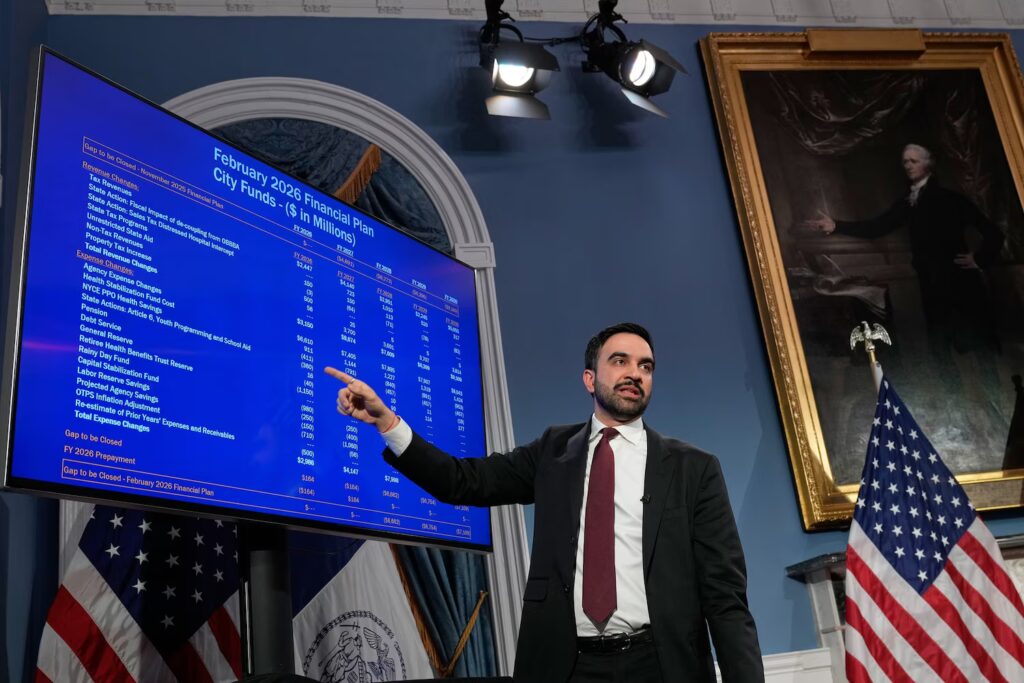
A looming debate between New York City Mayor Zohran Mamdani, New York Gov. Kathy Hochul and the city’s more moderate Democrats over proposed tax hikes could be a preview to the internal party battle that could play out in this year’s midterms, according to some political and economic experts.
The mayor revealed his proposal Tuesday to raise property taxes for the first time in over two decades as an option to balance the city’s budget. Mamdani contends that puts the onus on state lawmakers to avoid this “harmful path” by adopting his request to raise income taxes on the wealthiest people and corporations.
Hochul, who’s running for re-election this year, has dismissed calls to tax the rich and said she didn’t support Mamdani’s property tax hike proposal.
Mamdani top of mind as New York governor’s race ramps up
David Reiss, a clinical professor of law at Cornell Law School, told ABC News that it was inevitable that Mamdani’s progressive policies would be met with initial resistance by moderates in a highly contested election year, but the debate over taxation will be one that resonates across the country as affordability takes center stage at the ballot box.
“I have no doubt this will be a flashpoint for national elections and state and local elections as well,” Reiss said.
Mamdani weighs ‘last resort’ tactic for budget
During his announcement Tuesday, Mamdani acknowledged his plan for a 9.5% tax hike on three million residential units and 100,000 commercial buildings and using $980 million from the city’s rainy-day fund to help close the budget gap would weaken “our long-term fiscal footing and placing the onus for resolving this crisis on the backs of working and middle-class New Yorkers.”
Even after finding $1.7 billion in savings in his budget analysis, there was still work to be done to close the $5.4 billion budget gap without resorting to cuts to city services or personnel, Mamdani said, citing his office’s analysis of the budget.
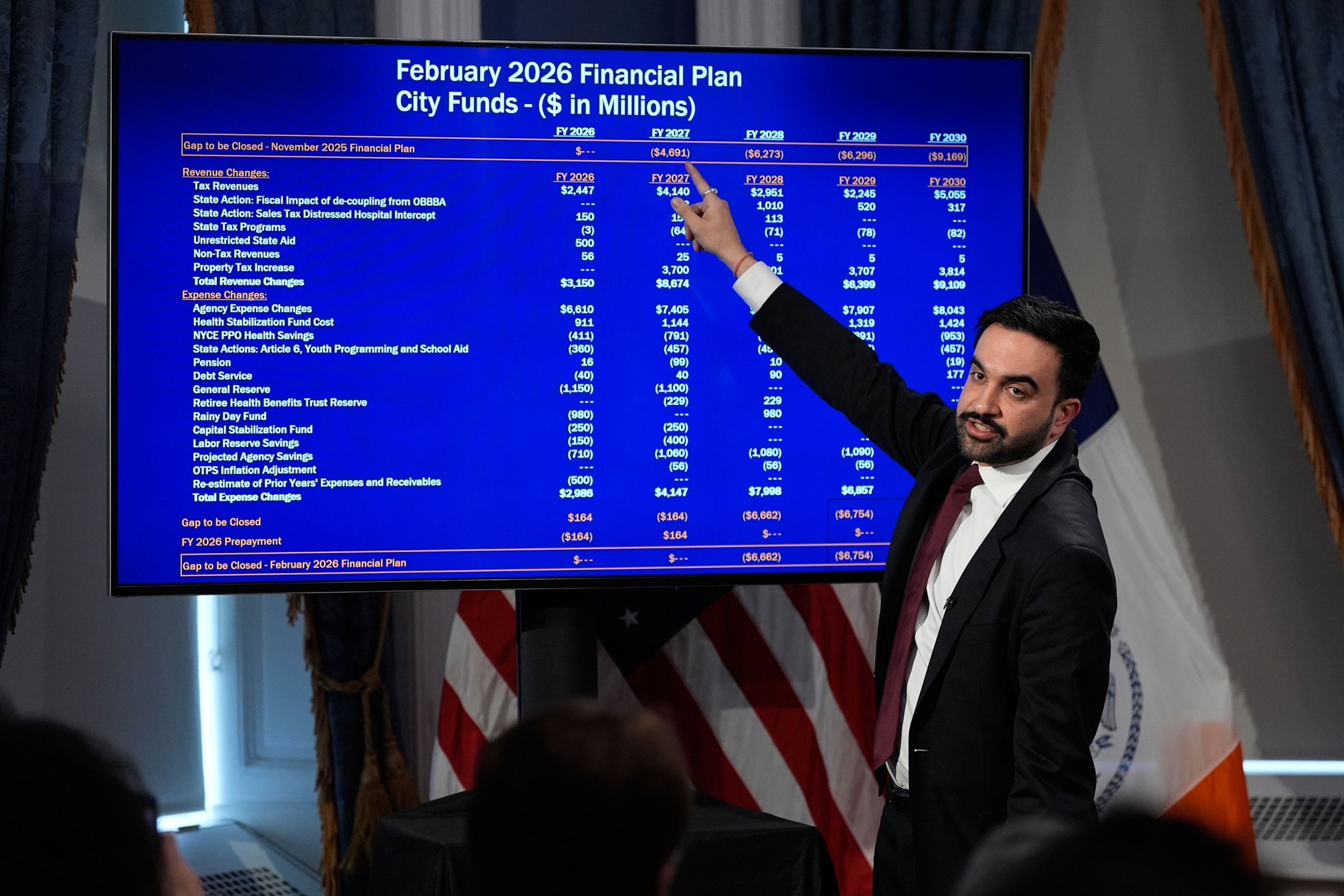
Mayor Zohran Mamdani speaks to reporters about the city’s finances during a news conference in New York, Feb. 17, 2026. Seth Wenig/AP
“We do not want to have to turn to such drastic measures to balance our budget. But, faced with no other choice, we will be forced to,” Mamdani, a Democratic Socialist, told reporters at City Hall on Tuesday while presenting his proposal.
Mamdani repeatedly said the property tax hike proposal was a “last resort,” and pushed Albany lawmakers to go with the “sustainable and fairest” path they have and increase the city’s taxes on residents making over $1 million a year.
Resistance among NY Democrats
Hochul, who has repeatedly said she will not raise income taxes, told reporters Tuesday that she didn’t agree with the mayor’s idea to target property taxes to balance the New York City budget.
“I don’t know that that’s necessary, but let’s find out what is really necessary to close that gap,” she said.
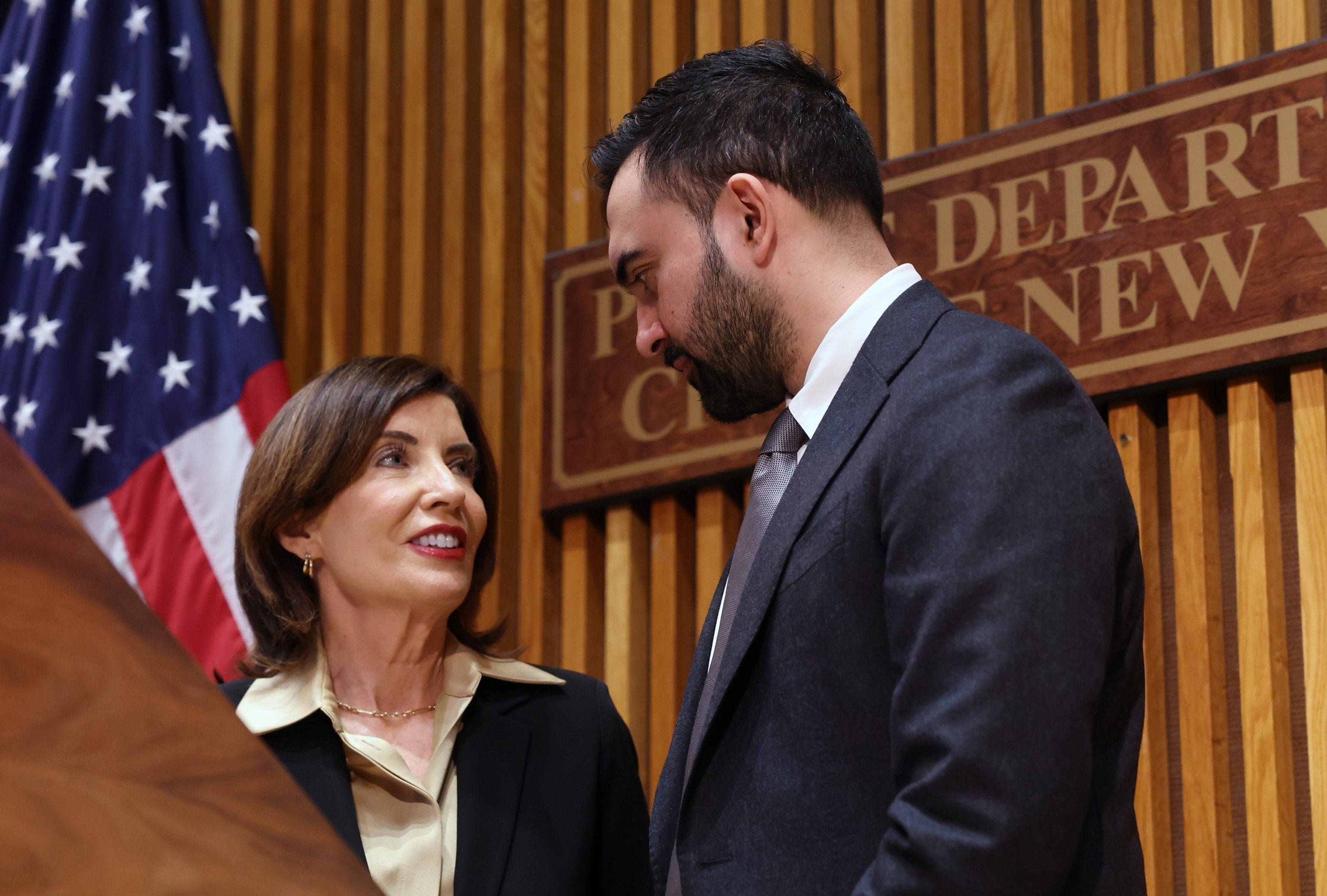
New York Gov. Kathy Hochul and New York City Mayor Zohran Mamdani attend a news conference at the headquarters of the NYPD, January 6, 2026 in New York City. Spencer Platt/Getty Images
Hochul’s sentiment was echoed by the leaders of the New York City Council, which must ultimately work with the mayor to approve a budget plan by a legally mandated June 30 deadline.
City Council Speaker Julie Menin and Councilwoman Linda Lee, who chairs the Council’s Committee on Finance, released a joint statement Tuesday pushing back on Mamdani’s proposals to increase property taxes and take money from the rainy-day fund, stating that both options, “should not be on the table whatsoever.”
Will the rich leave New York City after Mamdani takes office? Experts weigh in
“The Council believes there are additional areas of savings and revenue that deserve careful scrutiny before increasing the burden on small-property owners and neighborhood small businesses, which could worsen the affordability crisis,” said the council members, both of whom are moderate Democrats.
City Comptroller Mark Levine acknowledged in an interview with Spectrum News NY1 on Wednesday that the city does face “the biggest budget gap since the Great Recession.” However, he called a property tax increase “a very big mistake.”
“It’s an unequal system that actually has a heavier burden on working-class homeowners, especially in communities of color, and to add more taxes onto that unequal system is not the right strategy,” Levine said.
Levine added that Albany could do more to help financially and is “probably going to have to” make spending cuts.
The New York City branch of the Democratic Socialists of America, however, warned of the risks if the state didn’t raise taxes on the wealthy and the city was forced to seek revenue from higher property taxes.
“This budget is a choice between austerity and devastating cuts to working- and middle-class households or funding an affordable and abundant future for all,” the group said in a statement Tuesday.
A political game of chicken not limited to NYC
Reiss, who used to chair New York City’s Rent Guidelines Board, told ABC News that taxation has always been the big factor in elections, with Republicans previously running on a stance of no new taxes on Americans.
This year’s election season will be different, he noted, given Mamdani’s rise to national prominence, as well as that of progressive candidates who have been championing policies to help Americans make ends meet, such as improved child care and rent relief.
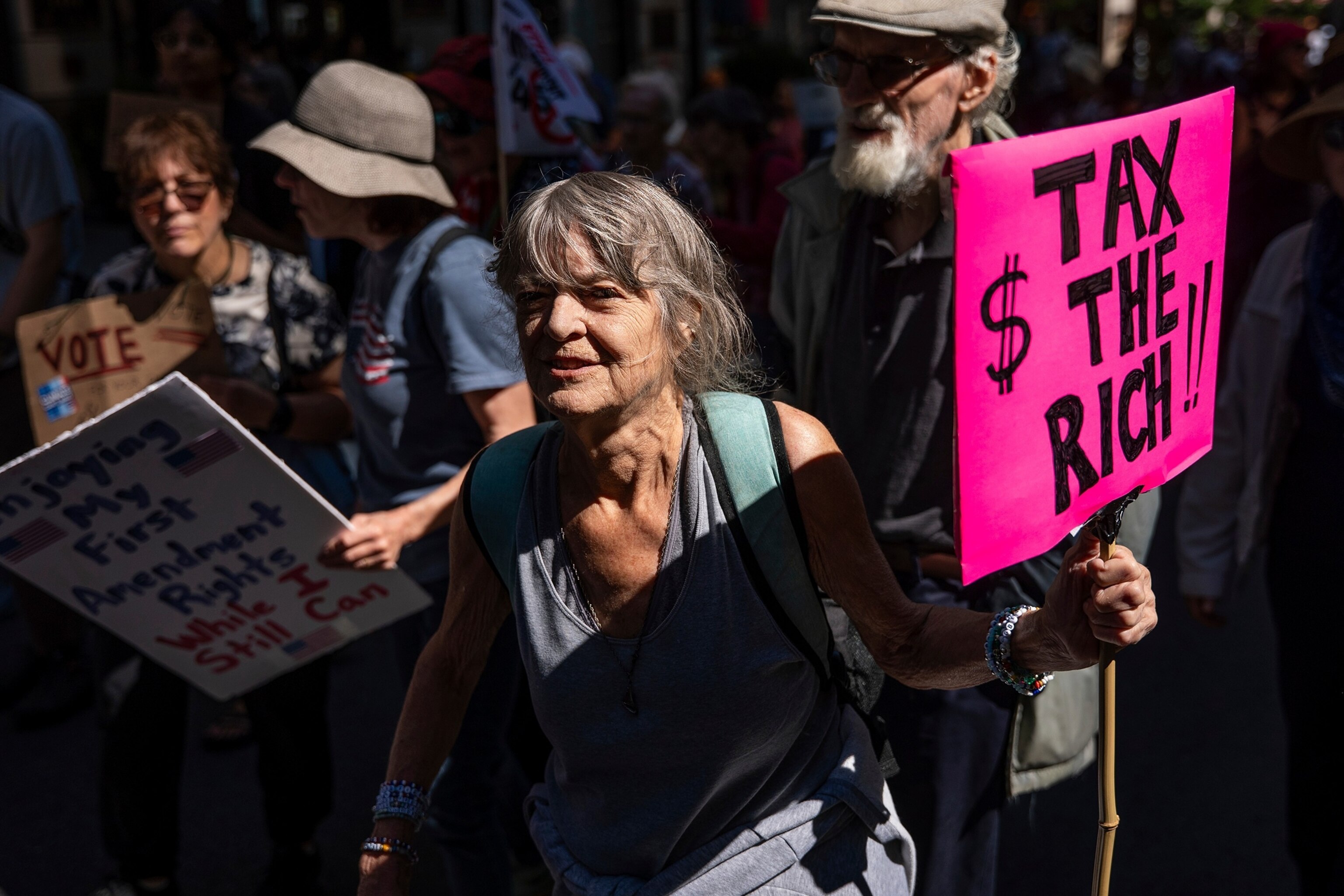
A woman carrying a “Tax the rich” sign marches through Manhattan at the “Make Billionaires Pay” climate protest, Sept. 20, 2025, in New York. Angelina Katsanis/AP
“You will see people say, ‘We want to increase revenues to support progressive issues,'” Reiss said.
Reiss said that Mamdani is “planting the flag” in a manner that is important to him and his supporters by making a property tax hike warning a part of his negotiations with the City Council and Albany.
Reiss further said that dangling a worst-case scenario this early puts the conversation on affordability and government fiscal priorities front and center, instead of it being buried under other issues that will surface as election season kicks off.
“You’re seeing a very popular mayor to use the bully pulpit for some change with a politically middle-of-the-road state government,” he said. “It really is a political game of chicken.”
Some compare Democratic socialism to communism. Here’s how the movements differ
Stephanie Kelton, a professor of economics and public policy at Long Island, New York’s Stony Brook University, told ABC News that it’s important to remember that budget negotiations are in the early stages and that all of the parties involved are aware of the particulars driving Mamdani’s proposals.
“It is an opening salvo. I don’t think anyone believes these are the only two options,” she said.
Kelton, who previously served as the Democrats’ chief economist on the Senate Budget Committee, said that the reaction to the taxation options will weigh heavily on the mayor, governor and City Council.
“Part of it is trial balloons and how the public will respond,” she said. “It can help apply pressure.”
Both Kelton and Reiss noted that the public push for more cost relief has seen leaders become more open to considering progressive policies.
Since Mamdani won the mayoral election, Hochul has been more open to some of his proposals to help New Yorkers, including expanding state funding for child care options for children aged two and older.
On Monday, the governor, whom Mamdani has endorsed, announced that the state would invest $1.5 billion in the city over the next two years for various services and programs, such as public health and youth services.
“It seems from a political perspective a logical strategy for a popular mayor to take, but it’s not without its risks,” Reiss said.

Timothy Weaver, an associate professor of political science at the University at Albany, told ABC News that by presenting New Yorkers with a worst-case scenario, Mamdani is laying the foundation for a potential compromise budget agreement, such as one that may include smaller tax hikes for both the wealthy and homeowners, that pushes his agenda forward.
“He can say we have avoided the worst and got a lot back,” Weaver said.
Weaver added that the quandary over taxation isn’t limited to New York. Last year, for example, Boston raised its property taxes after Mayor Michelle Wu made similar calls to the Massachusetts state legislature to tax wealthier individuals.
“This pattern is already playing out and is likely to continue to play out,” Weaver said.
Lawmakers across the country are facing growing calls from their constituents to address income inequality and the wealth gap, Reiss said, noting a proposed wealth tax in California on billionaires that has prompted some corporations threaten to leave the state.
“It’s the lightning rod, and it sets the terms of the debate,” Reiss said of Mamdani’s budget negotiation proposal. “But we’ll see if it compels other partners in government to go along or to resist it.”
Kelton agreed that Mamdani’s negotiation tactics will be widely watched and, if successful, likely emulated by other elected officials and political candidates.
“I think everyone is watching. This is a case study,” she said. “All eyes have been on [Mamdani] for so many different reasons: the message itself; the way it’s delivered; the messenger. How much is replicable in districts that don’t look like his? It will be interesting to watch.”
Author: Staff Writer | Edited for WTFwire.com | SOURCE: ABC News
: 82