Trump signals frustration with Iran as war powers deadline nears


WASHINGTON — Donald Trump said he is “not happy” with Iran as a key legal deadline approaches for the White House to seek congressional authorization for the ongoing conflict, underscoring uncertainty around both diplomacy and U.S. war powers.
Friday marks 60 days since the administration formally notified Congress of military action against Iran under the War Powers Resolution, a law that limits how long U.S. forces can engage in hostilities without legislative approval.
Legal deadline collides with fragile ceasefire
Under the law, the president must end military involvement within 60 days unless Congress authorizes the operation or grants an extension.
However, U.S. Defense Secretary Pete Hegseth argued that the clock has effectively paused because of a ceasefire reached in early April.
“We are in a ceasefire right now, which our understanding means the 60-day clock pauses,” Hegseth told lawmakers during a Senate hearing.
That interpretation has been sharply disputed by legal experts and members of Congress.
Sen. Tim Kaine countered that the statute does not support pausing the timeline, warning that the administration could soon face a significant legal challenge.
Trump expresses doubts over Iran negotiations
Speaking from the White House, Trump said talks with Tehran remain uncertain despite ongoing communication.
“We just had a conversation with Iran. Let’s see what happens,” Trump told reporters. “But I would say that I am not happy.”
The president suggested internal instability in Iran’s leadership has complicated negotiations, following the deaths of several senior military officials during the conflict.
According to Iranian state media, a new proposal for talks has been sent through intermediaries in Pakistan, though details remain unclear.
Debate over what counts as ‘hostilities’
At the center of the dispute is whether current U.S. actions — including a naval blockade of Iranian ports — constitute ongoing hostilities under U.S. law.
Legal experts argue that they do.
Professor Heather Brandon-Smith of Georgetown University said the blockade qualifies as an act of war and therefore keeps the clock running under the War Powers Resolution.
“A ceasefire is not a permanent end to the conflict,” she said. “Hostilities have not ceased.”
Similarly, Elisa Ewers of the Council on Foreign Relations warned that U.S. personnel remain at risk and that military operations tied to the blockade still fall within the law’s scope.
Oil markets react as tensions persist
Markets responded quickly to reports of a potential Iranian proposal, with oil prices briefly declining after weeks of sharp increases.
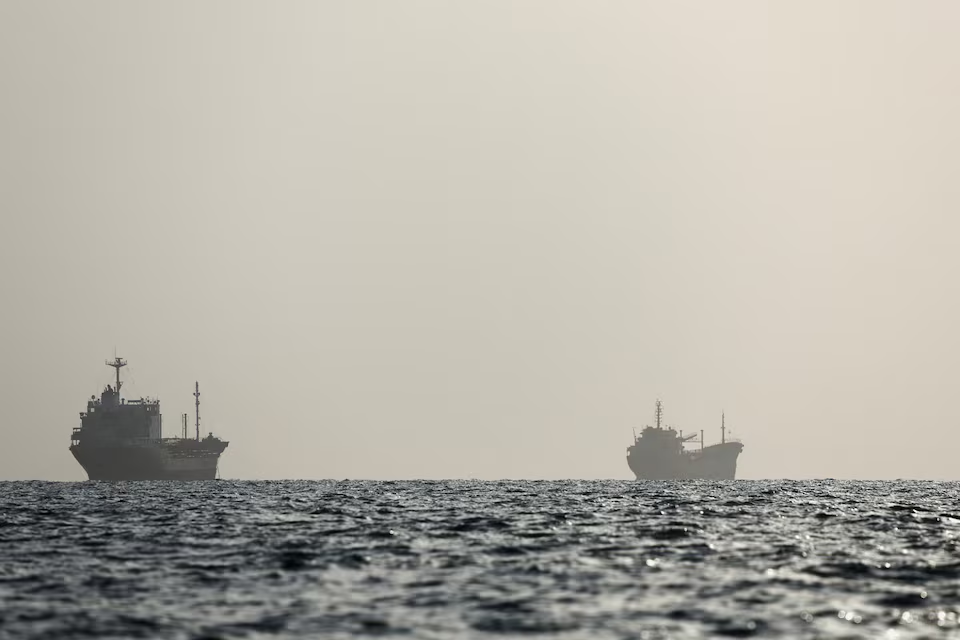
The conflict has disrupted global energy flows, particularly through the Strait of Hormuz, a key shipping route for roughly 20% of the world’s oil supply.
Despite the ceasefire, the strait remains effectively closed, continuing to pressure global markets and fuel economic uncertainty.
Congressional pressure builds
Behind the scenes, administration officials are reportedly in discussions with lawmakers about securing formal authorization for the conflict.
Efforts led by Democrats to limit Trump’s war powers have repeatedly failed so far, though some Republicans have signaled they may reconsider their stance if the conflict continues beyond the legal deadline.
Trump, for his part, dismissed concerns about the law’s constraints.
“The War Powers Resolution has never been adhered to,” he said, arguing that previous presidents have also exceeded the 60-day limit.
As the legal deadline arrives, the Trump administration faces mounting pressure over its interpretation of war powers, while negotiations with Iran remain uncertain and the risk of renewed escalation persists.
Author: Staff Writer | Edited for WTFwire.com | SOURCE: BBC News
: 321