US Labor Market Holds Strong While Housing Sector Weakens

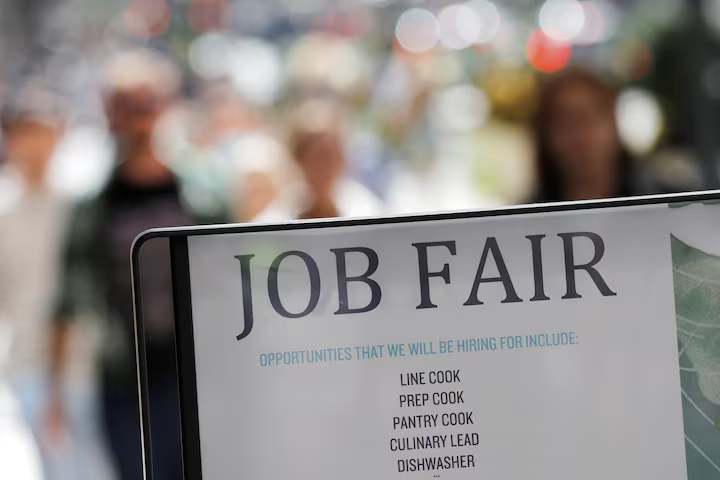
The United States labor market continued showing resilience in May despite mounting economic pressure from the war involving Iran, while the housing sector remained under heavy strain from rising mortgage rates and inflation.
New data released Thursday showed unemployment claims stayed near historically low levels, giving the Federal Reserve more room to focus on controlling inflation rather than supporting employment growth.
US unemployment claims remain low
According to the Labor Department, initial jobless claims fell by 3,000 to 209,000 for the week ending May 16.
Economists had expected 210,000 claims.
The data suggests employers are still holding onto workers despite:
- Rising oil prices
- Global supply chain disruptions
- Inflation concerns
- High-profile layoffs in the tech industry
Many technology companies continue cutting jobs as artificial intelligence reshapes hiring needs across the sector.
Still, overall layoffs remain relatively limited.
Matthew Martin, senior U.S. economist at Oxford Economics, said the labor market remains stable enough for the Fed to avoid immediate policy changes.
Iran war continues fueling inflation fears
The nearly three-month conflict involving the U.S., Israel and Iran continues disrupting global trade and commodity markets.
Shipping disruptions in the Strait of Hormuz have pushed up:
- Oil prices
- Fertilizer costs
- Aluminum prices
- Consumer goods expenses
Those higher costs are now filtering through the broader economy.
A new survey from S&P Global showed businesses faced their highest input costs since late 2022.
Companies are increasingly passing those costs onto consumers.
The report also showed:
- Private-sector employment fell to a 21-month low
- Services activity weakened
- Businesses reported growing supply shortages
Federal Reserve expected to keep rates elevated
Financial markets now expect the Federal Reserve to keep interest rates steady well into next year.
Investors currently see the Fed maintaining its benchmark rate between 3.50% and 3.75%.
Minutes from the Fed’s April meeting revealed growing concern among policymakers about inflation tied to the Middle East conflict.
Some officials reportedly discussed preparing for the possibility of future rate hikes if inflation continues worsening.
The Fed remains caught between:
- Controlling inflation
- Protecting economic growth
- Avoiding labor market deterioration
Housing market continues struggling
While employment data remained relatively strong, the housing sector showed fresh signs of weakness.
Single-family housing starts fell 9% in April to an annualized rate of 930,000 units.
Construction declined across all four major U.S. regions.
Building permits for future single-family homes also dropped 2.6%, signaling continued weakness ahead.
Economists say rising Treasury yields and mortgage rates are heavily weighing on home construction and affordability.
Mortgage rates hit nine-month high
The average 30-year fixed mortgage rate climbed to 6.51% this week, according to Freddie Mac.
That marks the highest level in nine months.
Mortgage rates have risen sharply since the Iran conflict began earlier this year, following increases in Treasury yields.
Homebuilders are also facing higher costs tied to:
- Imported lumber tariffs
- Construction materials
- Labor shortages
- Financing expenses
The National Association of Home Builders said builder sentiment remained depressed in May.
Residential investment continues contracting
Residential investment has now declined for five consecutive quarters, adding another drag on the U.S. economy.
Economists at Goldman Sachs lowered their second-quarter GDP growth forecast to 2.0%.
The economy also expanded at a 2.0% annualized pace during the first quarter.
Christopher Rupkey, chief economist at FWDBONDS, warned that affordability pressures will continue squeezing potential homebuyers.
“Inflation and financing is pushing building costs sharply higher,” Rupkey said. “That will make new homes even more unaffordable.”
Markets react to inflation and war concerns
Financial markets reacted cautiously Thursday after reports suggested Iran would not transfer its near-weapons-grade uranium abroad.
Oil prices rebounded following the news, while:
- Treasury yields moved higher
- The U.S. dollar strengthened
- Wall Street stocks declined
The benchmark 10-year Treasury yield recently touched its highest level since January 2025.
For now, economists say the labor market remains surprisingly durable. However, rising inflation and prolonged geopolitical instability continue threatening consumer demand, housing activity and broader economic growth.
: 246