Drive-Thru Restaurant Design: Inside the Race to Reinvent Fast Food

The drive-thru has been a cornerstone of the quick-service category for well over half a century. For much of that time, the model remained largely unchanged. Cars pull in, place an order, pay, pick up, and drive away. It was straightforward and didn’t leave much reason to rethink how things work.
But evolving consumer behavior is reshaping how restaurants show up in their physical spaces. The pandemic shifted channel mix permanently, and dine-in just isn’t as big of a priority for fast food as it once was. As a result, a growing number of brands are ditching indoor seating altogether. Others are redesigning layouts to move more volume through the outside lane. Even concepts that once operated without a drive-thru are adapting and building new prototypes around the channel.
Blueprints for Speed
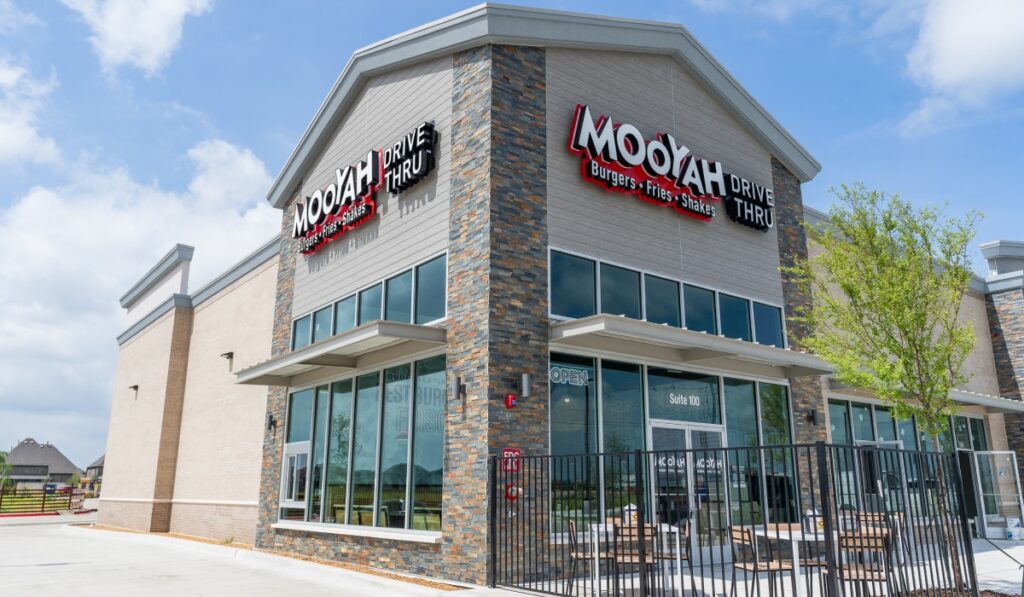
Every design choice for MOOYAH Burgers, Fries & Shakes lately has started with a core challenge: how to serve made-to-order food faster and more efficiently in the drive-thru, without compromising on its fresh, handcrafted ethos.
“Traditionally, it would take six to seven minutes for an order if you were in the restaurant to dine in,” says Landon Lane, senior director of construction and design at the Texas-based burger chain. “The biggest thing for us has been figuring out how to speed up that process and cut it in half without losing the things that we’re known for.”
MOOYAH is taking an iterative approach to answering that question. Its first drive-thru prototype opened last year in Frisco, Texas, and clocked in at 2,400 square feet. Just a few months later, the brand was already working on a 2,250-square-foot version for its second drive-thru site. Now it’s building a 2,000-square-foot model.
“We didn’t just go from 2,400 to 1,400 square feet,” Lane says. ”We’re going in that direction at a slow and steady pace, because you can cross a line where the footprint becomes too small for what you’re trying to do. We don’t want to reach that point.”
That measured downsizing has brought about some big changes to the kitchen layout. MOOYAH implemented a double-sided makeline, dedicating one side to drive-thru and the other to dine-in. A new pass-through window in the dining area eliminated the need for staff to walk through doors to serve in-store guests. The brand also added labor-saving tools, like an airmatic fry cutter and new grill technology that slashed patty cook times in half.
Another chain hailing from the Lone Star state is taking a similar approach. Taco Cabana recently debuted its 3.0 restaurant model, which shrinks the footprint by 1,000 square feet compared to earlier builds. The updated layout includes a smaller dining room, a walk-up window, and reconfigured kitchen flows that serve both drive-thru and dine-in with shared equipment.

Taco Cabana’s new prototype is 1,000 square feet smaller than previous iterations.
“The prototype encompasses a lot of our post-COVID learnings, when we started to see a shift in how the drive-thru was being used and how it fit into the overall scheme,” says director of franchising John Ramsay.
Taco Cabana only viewed its business in terms of drive-thru and dine-in for much of its nearly 50-year history. The drive-thru remains the dominant channel while dine-in traffic still hasn’t recovered to pre-2020 levels. In its place, a strong third-party delivery and takeout business has emerged—channels that Ramsay says were barely on the radar just a few years ago.
This shift has pushed the brand to rethink restaurant design. One key challenge has been accommodating the growing volume of delivery drivers without disrupting drive-thru operations. Taco Cabana now prioritizes dedicated parking spaces for delivery pickups and looks for larger lot sizes that allow the drive-thru to be positioned farther back on the property. That extra space helps prevent drive-thru backups during peak hours.
Another major shift, Ramsay says, is rising customer expectations around drive-thru speed. To address that, Taco Cabana introduced a double-lane ordering system with the 3.0 prototype. Two stations let customers place orders at the same time before funneling back into a single line to pay and pick up their food.
“Before, when it was a single line, it was like, ‘Oh geez, it’s going to take five minutes to even place my order, and then it’s going to take another three to five minutes before I get it,’” Ramsay says. “If you shorten the front end, they’re still fine with that three to five minutes from the time they order to the time they pick it up. That’s become really critical for us, because it creates both the truth and the perception that the speed of service is equal to or faster than it used to be.”
One area of tech investment that’s getting more attention centers on how drive-thru speed is measured. Traditionally, quick serves have relied on pressure-sensitive timers triggered by cars driving over buried sensors. But that system doesn’t actually measure the amount of time the customer experiences being in the drive-thru. It only measures the time from the first pressure point to the second pressure point.
Now, restaurants are exploring camera-based systems that track the full journey from lot entry to exit. They not only deliver a more accurate picture of service times as they’re experienced by the guest, but also prevent the kind of metric manipulation that can occur when employees ask cars to pull forward and park until their food is ready.
MOOYAH recently made that shift, replacing the loop detection and timer system used at its first drive-thru with a camera-based setup at its next. Lane says the change saves about $6,000 per unit in installation costs. Taco Cabana expects similar benefits, along with reduced long-term maintenance.
“You have to dig up your drive-thru lane if they conk out, which costs time and money,” Ramsay says. “Being able to position these sensors at different locations, adjust them based on your site conditions, and not being tied into literally bearing it in concrete—we think that’s going to be a really important piece of the puzzle for us.”
Krystal is another brand that’s rethinking its physical footprint. The 90-year-old sliders chain is remodeling locations and testing new prototypes that improve visibility, update menu boards, refresh interior spaces, and better organize outdoor layouts so different channels don’t interfere with each other.
Amanda Hyde, senior VP of operations, notes that about 80 percent of the brand’s sales come through drive-thru, 10 percent via third-party delivery, and 10 percent dine-in, with some locations reaching 94 percent drive-thru sales. When that volume becomes a liability, the team considers adding a second lane—typically when traffic jams or bottlenecks begin impacting customer experience.
“When guests report having to pull away because of long waits, nine out of 10 times it isn’t about the food preparation taking too long,” Hyde says. “It’s just the sheer amount of cars, which is something that we can navigate much better if we can get a dual drive-thru there.”
A second lane isn’t always a plug-and-play option, though. Hyde says a dual-lane configuration requires extended space behind the building, and must account for parking, entry and exit flow, and total site layout.
“That takes a whole big navigating strategizing session,” she says.
Operational upgrades are also part of Krystal’s effort to improve speed and volume. Some locations are rolling out a double-window system with one window for payment and one for food handoff. This lets two employees work in tandem, reducing overall dwell time. While one team member finalizes payment, another can prep and pass off the next order.
Technology is key in the remodels, too. Krystal uses digital menu boards—some static but remotely controlled for easy updates, others dynamic, rotating product info to promote loyalty programs and daypart-specific offerings.
“We’ve realized that having those digital menu boards does save money in the long term,” Hyde says. “Just think about changing a price or making an adjustment if you don’t have them. That’s physical, manual work of going out and getting it just right, of printing and distributing materials to all of our almost 300 restaurants. It keeps everything so much more in sync and lets you make real-time changes.”

Roughly 80 percent of Krystal’s sales come via the drive-thru.
To manage costs, digital boards may be limited to drive-thru and interior spaces, with vendor testing ongoing. Hyde adds that Krystal must consider longtime customers who “don’t 100 percent understand technology,” so the brand avoids tech that might confuse or alienate guests, favoring simple, accessible solutions.
Real Estate Realities
Securing high-quality drive-thru real estate remains a persistent challenge for nearly every brand. Lane says it’s an ongoing issue that shows no signs of easing anytime soon.
“Every year it gets more and more competitive for sites,” he says. “It just seems like every time you put in for something, there’s two or three other companies or franchisees trying to do the same thing.”
That’s why MOOYAH has leaned into conversions and started targeting second-generation restaurant sites with infrastructure already in place. Lane says it’s a strategy that can dramatically reduce upfront costs if brands play it smart.
The key is adaptability. MOOYAH doesn’t come in with rigid layout requirements or insist on major tear-downs. The goal is to work with what’s already there.
“We’re not coming in and saying, ‘you’ve got to tear out this wall’ or ‘those restrooms need to be moved over here,’” he says. “There’s not a hard line on what the restaurant looks like because it can get costly when you start moving pieces around. If you’re not careful, you can manipulate it so much that all of the sudden those advantages of the second-generation site are gone.”
Ramsay says Taco Cabana has taken a more deliberate approach to where and how it builds lately. As the brand ramps up expansion with a recently launched franchising program, it’s thinking in longer timelines and planning site development up to four years in advance.
“It’s really important for us to get in early and start working with the developer—going in with the mindset of what we want to achieve with the drive-thru, with the parking, with the ingress and the egress,” he says. “It’s about being ahead of the curve, so that we aren’t coming in and having a developer telling us, ‘Here’s your curb cut. Here’s your footprint. Good luck.’”
Ramsay says one of the biggest lessons has been understanding what the brand wants to achieve before a site is even presented. And in today’s high-cost construction environment, that includes being willing to walk away if the setup isn’t right.
Site selection still involves traditional considerations like demographics and trade areas, with Taco Cabana seeing traction in newer developments with growing residential bases. Entering early gives the brand a chance to establish itself before competitors flood in. That said, expansion won’t always mean greenfield builds. Ramsay acknowledges that in more mature markets, second-generation sites will come into play. He says the team is more cautious now, recognizing that a site with a history of failed restaurants might not be worth the risk even if it’s in a strong trade area.
“You have to be very deliberate about which markets you go into, and you have to be willing to walk away when you need to,” Ramsay says. “It might be a great trade area, but if it’s a secondary site that’s been three different restaurants over the last six years, you have to be a bit humble and say, ‘OK, maybe we’re not going to be successful either.’ Maybe there’s something wrong with the site, and we can’t be so snobbish to think that we’re going to be the ones to all of the sudden crack the code.”
When evaluating potential sites, one of Krystal’s top priorities is ease of access. If getting in and out of the location is a hassle, it can cost business.
“Those medians where you have to make a u-turn to go in? That’s a big deal,” says Hyde. “It really just takes the guest right down to the next place. Sometimes they will just settle for something else because they don’t want to deal with that.”
The team also looks closely at the long-term viability of a site. That includes understanding the surrounding area’s trajectory—what’s moving in or out, upcoming roadwork or construction, and whether the neighborhood is gaining or losing relevance.
“A lot of our locations have been there since the ’70s or even earlier,” Hyde says. “We hear things like, ‘All the good business is on the other side of the highway now.’ That’s why it’s important we’re doing our research and really understanding not just what’s happening today but what’s coming down the line.”
Even small factors like signage and visibility can tip the scales. Hyde says Krystal weighs opportunities for billboard placement, highway exposure, and on-site branding when evaluating whether a potential location will deliver.
“If we’re going to put a restaurant somewhere, even if the numbers make sense, we also have to look at what opportunities there are for us to continue to support that restaurant down the line,” she says.
That future-focused outlook is critical, Hyde adds, because she doesn’t see the shift toward the drive-thru and away from dining rooms reversing anytime soon.
“Before, I think the drive-thru was seen as something that was very convenient,” she says. “Now it’s pretty much mandatory, and it’s only becoming more important as the entire world keeps moving at a faster and faster pace.”
Author: Staff Writer | Courtesy of “Forbes” | Edited for WTFwire.com | SOURCE: QSR Magazines
: 86