KFC global growth surges as flagship stores set new pace

Nivera Wallani, KFC Global’s chief development officer, celebrated 15 years with the brand in November, spending 11 of those on the Canadian business, including president and general manager, before being promoted to the worldwide function.
It’s been an eventful decade-plus concerning development, to make an understatement only few retail companies in the world could relate to. KFC today opens a restaurant roughly every 3.5 hours (it’s been closer to 3 hours recently). And over the first half of the decade, it built nearly 10,000 stores. If you think about that as a percentage of KFC’s larger fleet (it ended Q3 with 32,951 restaurants, including 29,371 international), the chain developed a little less than a third of its entire base over the past five years. “It is a staggering number,” she says.
Yet Wallani finds herself at a juncture that’s familiar to many in the category. Chicken is as hot a segment as there is in QSR. That’s led to myriad challenger and legacy brands jostling for share, stateside and abroad. KFC, she says, doesn’t view this surge as an impediment. “We want to continue to lead the industry in terms of our scale and size,” Wallani says. “Competition is growing and competition is building internationally. Our scale of growth compared to the international chicken competition is significant. And we feel like we have an opportunity to go even faster.”
To put measures in perspective, Popeyes parent company Restaurant Brands International shared in June the chicken chain had about 300 units in Asia Pacific. KFC is north of 19,000. Chick-fil-A is making a 10-year, $75 million investment to expand in Asia, but hasn’t quite gotten started yet—the Singapore debut is slated for late 2025. There’s no shortage of comparable cases.
“We have leadership position in many countries around the world,” Wallani says. “We want to maintain that and really just set a new bar for how QSR chicken can grow. … The first part of this decade, almost 10,000 restaurants. Next part of this decade? A lot of opportunity and ambition to go even faster.”
Yum! Brands CEO Chris Turner said in Q3 KFC believes there’s room for at least 75,000 global locations. “Honestly,” he said, “there’s whitespace opportunity in just about every market for KFC.”
Nearer term, KFC is on track to add nearly 3,000 new restaurants in fiscal 2025 on a gross basis (760 arrived last period), which would set a record for the 1952-founded brand. It upped net 970 stores year-to-date headed into Q4, including 1,059 net international alongside a U.S. retraction of 89.
KFC, responsible for 53 percent of Yum!’s divisional operating profit, delivered 14 percent core operating profit growth last quarter, driven by 6 percent unit expansion and 3 percent same-store sales growth. While the U.S. remains a turnaround story, several international markets posted robust figures, including the U.K. up 9 and 6 percent in same-store sales and traffic, respectively, and South Africa generating 7 percent comps on water mark youth engagement. South Korea and Brazil secured double-digit transaction growth as well. South Korea’s performance was its third consecutive above the 10 percent line for sales and traffic and should reach 5X net unit growth compared to 2024.
China, good for 27 percent of system sales at KFC—the U.S. is 14 percent—saw its system number hike 6 percent in Q3.
And part of KFC’s growth makeup, though perhaps less publicized, has begun to pick up in Europe, where the company aims to double the number of stores across the continent within the next five years. There are presently more than 2,200 across 40 countries. This includes “flagship” restaurants like one that opened steps from the Baroque masterpiece Trevi Fountain in Rome. It tops a list of iconic builds, alongside a new restaurant in Prague (opened last year), a KFC with a view of the pyramids in Cairo, and modern designs like a venue in Play Braam, South Africa.
Wallani says KFC’s desire to jumpstart European development isn’t a mysterious one. Strong transaction results and AUVs reflect consumer affinity. So, from a business case, it’s a market that’s going to produce returns.
Secondly, she adds, KFC touts a strong and well-capitalized franchisee base in Europe with growth ambitions.
As KFC scales in Europe, Wallani says, it’s going to pay attention to how it shows up and, generally, look to accomplish three things: Firstly, how does it spotlight the brand to the market? Secondly, what is the meaning of the store? Lastly, how can it ensure it is culturally integrated within the fabric of the region?
Or, put succinctly—brand, culture, and context.
The Trevi Fountain KFC, for instance, which is 100 meters away from the 18th-Century landmark, signaled a “pivotal step” in KFC’s broader European strategy and marked one of the first Western European strongholds.


KFC plans to add more “flagship” venues in iconic European locations.
KFC managing director of EMEA Dhruv Kaul called it the “most modern and ambitious” KFC in Europe yet. It covers nearly 1,000 square meters (nearly 11,000 square feet) across two floors and represents the most technically advanced KFC in the market. It’s also one of the first to offer consumers “KWENCH by KFC,” which serves a range of specialty drinks such as Cherry Poppin’ Boba and Caramel Crunch Shakes. KWENCH was piloting across three markets in Q3.
The digital-first restaurant also includes a “Rome Bucket Order Point,” and, as Wallani noted, design ticks that pay heed to Rome’s heritage at architectural points, such as Colonel Sanders riding a red bike diners see when they walk in and can take pictures with. There are bow-tie chairs and KFC added green hues to its typical black or red palette to honor Italian culture. It was an effort, she says, intended to create an authentic, relatable, and iconic experience.
Flagship KFCs, Wallani adds, are vital because the brand understands what’s at stake. They will almost assuredly be high-flight and welcome local consumers as well as hordes of international people visiting nearby attractions. “There typically is a higher expectation of the type of experience you’re going to have in a flagship,” she says. “So, we really wanted to elevate the experience [in Rome].”
KFC will continue to develop enhanced stores alongside more typical ones, say an inline in a bustling city like London. And, again, flagships factor into a back-half of the decade where KFC hardly expects to slow down.
Wallani, speaking from a personal point, says her 15 years with the brand blinked by “really fast,” which she chalks up to enjoying her job and the blurring pace of the business.
“We’ve got a culture that’s pretty special and unique that really draws people in and it’s something that is very hard to find outside of Yum!,” she says. “So that keeps me connected to the organization. In my 15 years, I’ve had an opportunity to work across different finance roles and general management. The opportunities in terms of growth and development are incredible. It’s kept me interested and, more than anything else, I’m having a lot of fun.”
Her role took her across the globe to see how KFC manifests in places like Rome, Japan, and Korea, where she visited recently. There’s a chance, she says, even with all that expansion, to still translate learnings on the local, market-by-market level, and plant seeds in different places. Wallani added five countries to her list in 2025, including Australia, Czech Republic, and Korea. Brazil and Argentina are on deck for this coming calendar.
Overall, she’s visited more than 50 countries growing the KFC brand.
Additionally, since January, it’s come under fresh direction with Scott Mezvinsky, who was promoted atop KFC in January from his title as president of Taco Bell North America and International. He, too, appreciated KFC roots going back to GM of KFC Iberia and CDO and VP, Development, and Operations of KFC’s Latin America and Caribbean market.
She says Mezvinsky brought energy and focus to some of her earlier points—namely around how chicken in QSR crowded of late, and for good reason given shifting protein preferences. “We should own chicken in our way with a lot of pride,” Wallani says. “And I think we do that and have opportunities to continue to do that.”
“I think the second thing,” she continues, “is even though the competition is ramping up in parts of the world where we’ve been for a long time and the competition is coming in, there are two ways to look at that: Either you’re afraid and you respond in a defensive way, or you get energized and respond in an offensive way. … That’s the approach we’ve taken.”
In plain terms, Mezvinsky wants KFC to double down on what it’s known for, which happens to be a space competitors are racing to grab a piece of.
Wallani adds the brand continues to scout for flagship real estate to join its Rome, Prague, and Cairo stores, as it approaches record development. “The bar is really high,” she says.
More largely, KFC wants to strike a balance through the lens of what it calls, “the next-gen consumer.” It’s a guest profile marketers are plenty familiar with. Wallani explains it as people with access to more information, tech, and data than ever. And with that much coming at them, they can struggle to be inspired.
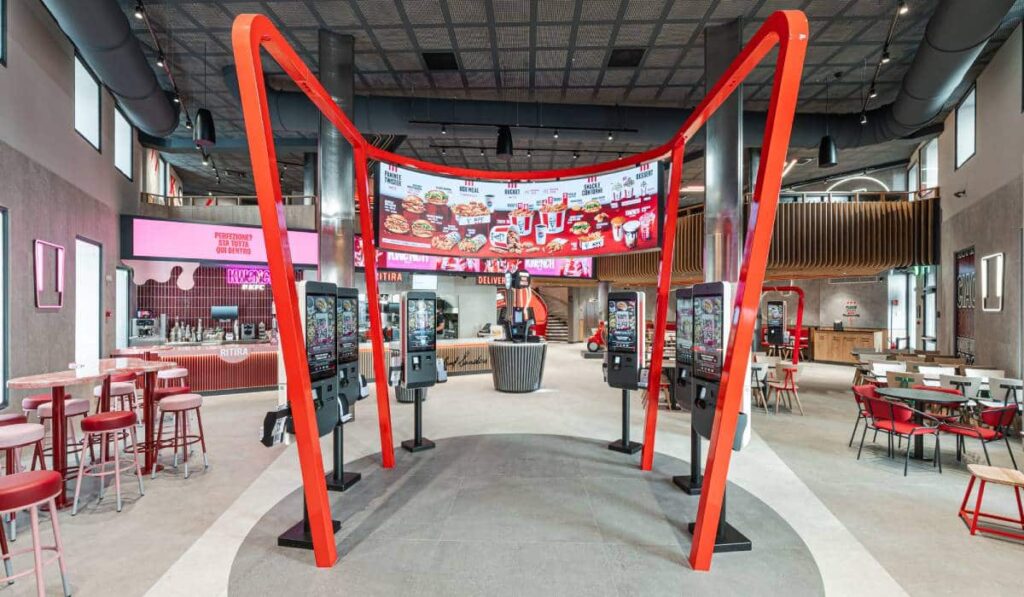
So, KFC hopes to create connective and unforgettable spaces anchored by modern systems. “We know this consumer is a native digital consumer and they’re used to things being easy. Technology has to play a role at specific points within their journey with the brand that we can just make extremely easy for them,” Wallani says. “They’re inundated with choice all the time. Instead of inundating them with more choice, how do we just make it easy?”
“A lot of their engagement is done across a screen, with people or on a screen,” Wallani tacks on. “And so, if we can create spaces in our restaurants where they actually want to be to have an in-real-life connection—that is another thing that we’re trying to do as we think about our restaurant design and that experience.”
KFC wants to find a spot between the digital world and one where hospitality is part of who it is and what it does. The brand’s global digital sales mix reached 63 percent in Q3, supported by kiosk adoption and aggregator partnerships.
“We are a brand that is many, many years old,” Wallani says. “I think one thing that excites me is we’re always ensuring we’re innovating, whether it be around our restaurant design, whether it be around our menu, whether it be around our experience, digital, and if I think about this flagship [in Rome] specifically, it’s bringing a lot of innovation together in one spot. And it’s something that I feel excited by and I’m sure our franchise partners who have partnered with us in the restaurant feel the same way.”
Author: Staff Writer | Edited for WTFwire.com | SOURCE: QSR Magazine
: 97