Cicada Covid variant spreads more easily among kids

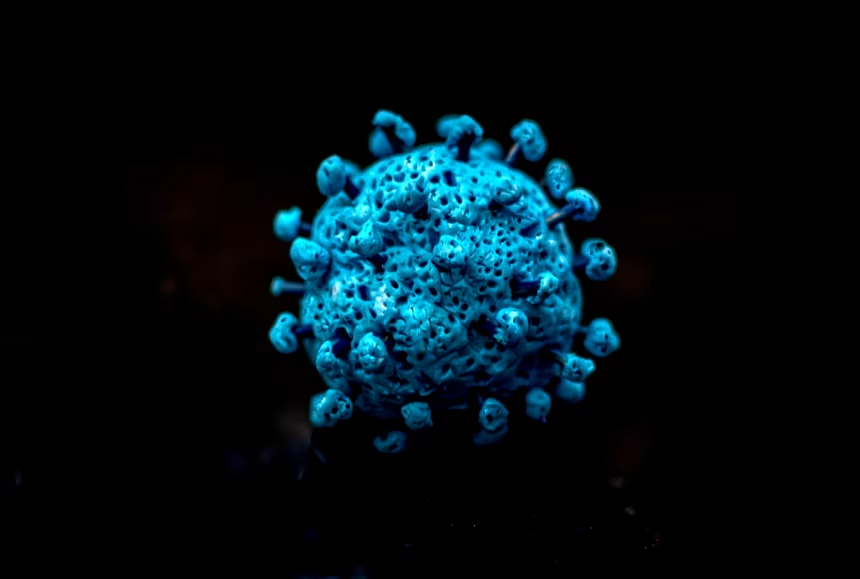
The Cicada Covid variant, known scientifically as BA.3.2, is drawing attention from researchers for an unusual reason: it appears to infect children more easily than adults.
Even so, scientists emphasize that the variant is not causing more severe illness. Instead, its behavior offers new clues about how the virus continues to evolve.
First detected as a quiet offshoot of the Omicron family, BA.3.2 has now been identified in more than 20 countries and in wastewater across multiple U.S. states, according to the Centers for Disease Control and Prevention. While overall Covid-19 levels remain low, experts say the variant may be more widespread than current testing suggests.
A variant that stayed hidden before reemerging
Compared with earlier strains, BA.3.2 carries an unusually high number of genetic changes. These mutations may help it partially evade immunity from past infections or vaccination. However, the variant has not demonstrated the ability to dominate globally.
In fact, researchers say it may have lost some efficiency in binding to human cells, limiting its spread compared with previous variants.
Why children may be more affected
One of the most striking findings is that the variant seems to infect children between ages 3 and 15 more frequently than adults.
Data from New York City suggests kids may be up to five times more likely to contract BA.3.2 compared with other variants. Scientists are still investigating why.
Some experts believe children’s immunity—built from fewer past infections or vaccinations—may fade faster. Others point to genetic changes in the virus that could alter how it interacts with the immune system.
There is also a simpler explanation: children are often exposed to more viruses in schools and social settings, making them easier targets for transmission.
Vaccines still work, but updates may not be needed
Despite its mutations, the Cicada Covid variant does not appear to require a new vaccine formulation.
Studies suggest that existing vaccines continue to provide protection, and there has been no increase in hospitalizations or deaths linked to BA.3.2.
Some scientists even argue that the variant’s impact is too limited to justify updating current vaccines. Instead, they recommend monitoring it closely for any changes.
A variant to watch, not fear
For now, BA.3.2 remains a scientific curiosity more than a public health threat. Its ability to infect children more efficiently is notable, but not alarming on its own.
Experts say the real value lies in what it reveals about viral evolution. Each new variant helps researchers better understand how Covid-19 adapts—and how future threats might emerge.
The Cicada Covid variant may not drive the next wave, but it is another reminder that the virus continues to evolve in unexpected ways.
Author: Staff Writer | Edited for WTFwire.com | SOURCE: CNN News
: 46