Doctors Warn Kids Are Microwaving NeeDoh Toys and Getting Burns

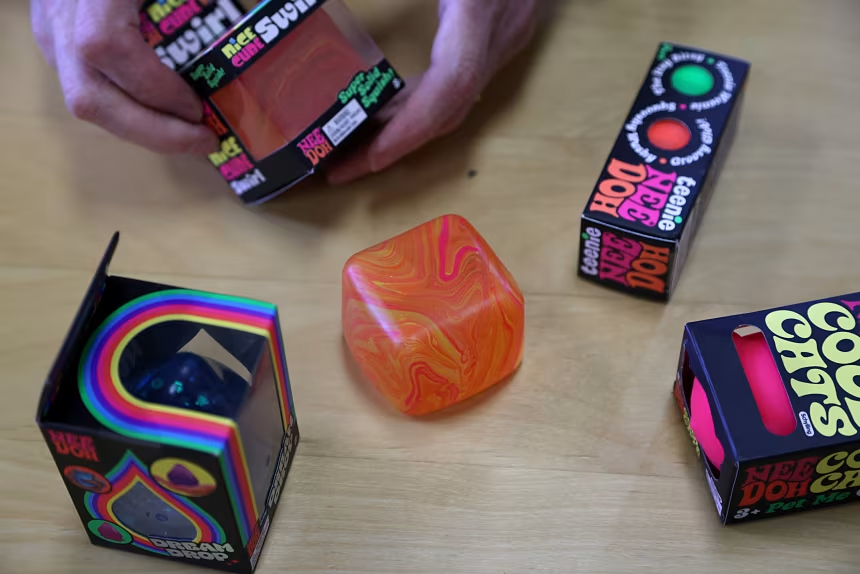
Burn centers across the United States are treating children with serious injuries after a social media trend encourages kids to heat gel-filled NeeDoh sensory toys in the microwave — a practice the toymaker explicitly warns against and one that can cause scalding, sticky liquid to explode onto a child’s face, hands, and arms.
What Is Happening
NeeDoh toys, produced by the company Schylling, are popular gel-filled squishy sensory toys widely used by children. Videos circulating on YouTube and TikTok have shown children microwaving the toys to soften them, prompting others to try the same. When overheated, the toys can burst, sending superheated gel onto skin. Because the gel is extremely viscous — similar in consistency to glue — it adheres to skin and continues burning, making it difficult and painful to remove.
The Schylling website explicitly states: “NeeDoh products are designed to stay sealed and should not be cut open, eaten, heated, frozen, or microwaved, as misuse can damage the toy and create safety risks.”
Burn Centers See Rising Cases
Dr. Emily Werthman, manager of the Johns Hopkins Burn Center in Baltimore, said her facility alone has treated approximately a dozen such cases recently. “If you ask burn centers throughout the country, they will tell you the same thing,” she said. “Unfortunately, those handfuls at every burn center add up to an unfortunately large number of kids who are getting injured.”
Burns from the trend range in severity from redness similar to sunburn to deep blistering injuries that cause scarring. The gel can also splash onto children’s faces and eyes, adding another dimension of danger.
“It’s incredibly painful for these patients,” Werthman said. “It just peels the skin away with it, which is really psychologically disturbing to a little kiddo.”
A Family’s Account
Whitney Hand, an Atlanta mother, describes the moment her fifth-grade daughter microwaved a NeeDoh SplootSplat toy after seeing the idea on YouTube. When her daughter removed the toy from the microwave, it exploded, sending boiling gel onto her face and arm.
“It’s so viscous, it’s like glue, and so for it to be boiling hot and on her skin, I started to try to wipe it off, but it was pulling her skin off with it,” Hand said. Her daughter did not require an emergency room visit but sustained mild scarring on her face and more significant scarring on her arm. She has been applying sunscreen diligently this summer to protect the healing skin.
“She’s a girly girl, so it was pretty emotional for her to have a burn on her face for a while,” Hand said. “She was pretty embarrassed about it and didn’t like going out.”
Risk Extends Beyond Microwaving
The danger is not limited to intentional misuse. Dr. Werthman warned that the gel-filled toys can also pop and burn children inadvertently if left in hot cars or left sitting in direct sunlight. “We should be really teaching kids not to leave them in the car, or on the pool deck, or wherever it’s going to be overheated,” she said.
Social Media’s Role in Spreading the Trend
Dr. Maneesha Agarwal, a pediatric emergency medicine physician at Children’s Healthcare of Atlanta and Emory University School of Medicine, noted that the NeeDoh toy microwave burn children warning applies to all gel-filled sensory toys, not just the NeeDoh brand. The core danger — a hot, sticky substance that is difficult to remove quickly — is common to all similar products.
Dr. Leah Middleberg of Nationwide Children’s Hospital in Columbus, Ohio, and a member of the American Academy of Pediatrics’ Council on Injury, Violence and Poison Prevention, noted this follows a pattern of dangerous social media challenges. “The dangers of these challenges seem pretty obvious to adults, but kids have been doing risky things for a long time — it’s just that now bad ideas spread wider and faster online.”
TikTok searches for microwaving NeeDoh toys now return a safety warning rather than video content. YouTube said it has removed content that violates its harmful activities policy and that material showing minors participating in unsafe activities is taken down under its child safety rules.
Consumer Reports sent a letter to the Consumer Product Safety Commission last year urging an investigation into NeeDoh-related burn reports. The CPSC did not comment on whether an investigation is planned.
What to Do if a Child Is Burned
Medical experts advise the following steps if a child is burned by hot gel from a NeeDoh or similar toy. First, use a clean towel moistened with cool water to remove as much of the hot gel as possible — the adult doing so should take care not to burn themselves in the process. Second, cool the wound with cool running water. Do not apply ice, butter, oil, or any other substance. Then seek emergency care if the burn affects the face, hands, or groin area, or if blisters are forming.
“They can appear kind of superficial looking, but because of the way that it sticks, they end up being a little bit deeper than you think they may be,” Werthman said.
How to Keep Kids Safe
Experts urge parents to talk directly with their children about the trend — even young children who are not on social media themselves, since the trend spreads through siblings and peers at school. “Even if you think ‘My six or seven year old is not on social media, they’re not going to know about this’ — they probably are,” Werthman said.
Agarwal advised parents who cannot trust their children to use toys safely to remove the toys from the home entirely. “Not everything on social media is a good idea to copy or to do,” she said.
Author: Staff Writer | Edited for WTFwire.com | SOURCE: CNN News
: 37