The 6 biggest changes in the new US dietary guidelines


The U.S.’ new dietary guidelines, unveiled Wednesday, make notable changes to the country’s prior guidance about healthy eating, placing a higher emphasis on protein and full-fat dairy while advising people to avoid sugar and highly processed foods.
“My message is clear: Eat real food,” Health Secretary Robert F. Kennedy Jr. said Wednesday at a White House briefing, adding that he was “ending the war on saturated fats.”
Kennedy, who has vowed to tackle rising rates of chronic disease among children, touted the guidelines as a way to reduce high levels of obesity and diabetes.
The guidelines, issued jointly by the Agriculture and Health and Human Services departments every five years, stop short of a sweeping overhaul. They reiterate previous recommendations to consume nutrient-dense fruits and vegetables, as well as healthy proteins such as meat, poultry, seafood, nuts and seeds. However, they invert the food pyramid used in the 1990s and 2000s to emphasize meat and dairy over whole grains.
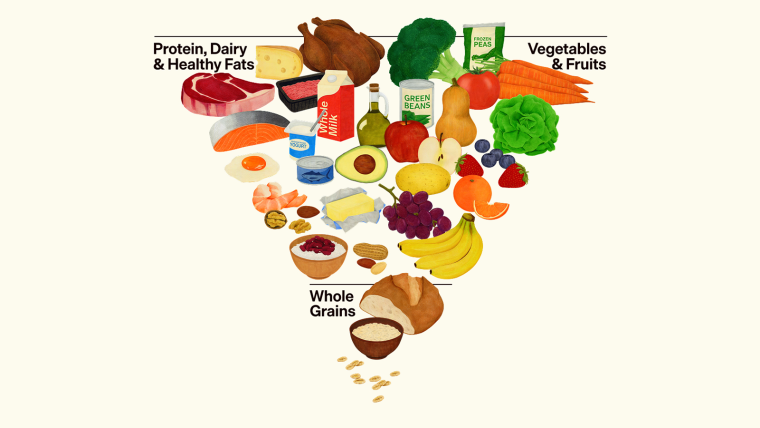
Dietary Guidelines for Americans as stated by the Agriculture Department. U.S. Agriculture Department
Here are six of the biggest changes from the previous recommendations.
Protein at every meal
The new guidelines suggest prioritizing protein at each meal, with a goal of getting around 1.2 to 1.6 grams per kilogram of a person’s body weight each day. The government recommends protein from animal sources such as eggs, poultry, seafood and red meat, as well as plant-based sources such as beans, peas, lentils, legumes, nuts, seeds and soy.

Cartons of eggs at a Walmart store in Columbus, Ohio. Brian Kaiser / Bloomberg via Getty Images
“The old guidelines had such a low protein recommendation that we are increasing that by 50% to 100%. Kids need protein,” FDA Commissioner Marty Makary said at the briefing.
However, several nutrition experts said protein deficiencies aren’t a concern.
“I really don’t think children in the U.S. suffer from a lack of protein,” said Dr. Ronald Kleinman, emeritus chair of pediatrics at Mass General Brigham.
“We need about 7 or 8% of calories to be protein. And in the U.S., most children [get] 15-plus percent of protein in their diet,” he said.
Full-fat dairy is in, low-fat is out
Whereas the previous guidelines recommended fat-free or low-fat milk and yogurt, the updated version prioritizes full-fat dairy with no added sugars. The new version recommends three daily servings of dairy, while the prior version recommended three daily cups.
The change could have an impact on school lunch programs, through which kids are currently offered fat-free or low-fat milk.
Some research has suggested that full-fat dairy can decrease the risk of obesity, perhaps because it’s more filling and people eat less as a result. Studies have also found that it may improve heart health, or at least won’t increase the risk of heart disease.
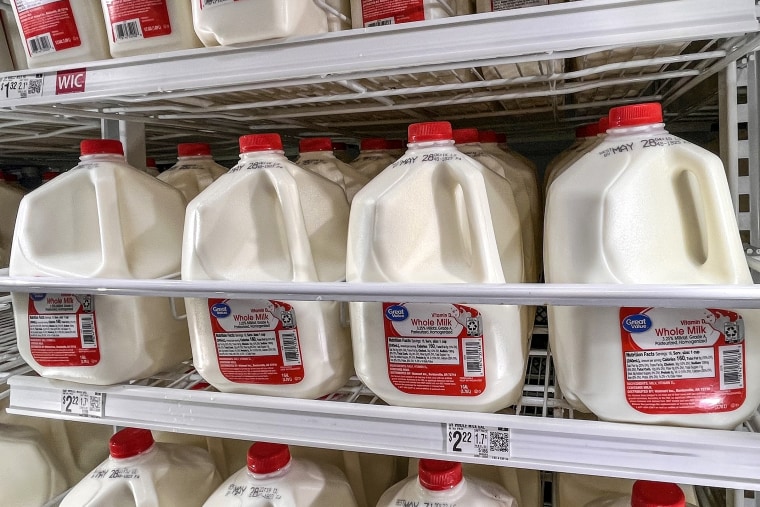
Bottles of whole milk at a Walmart supermarket in Houston.Ronaldo Schemidt / AFP via Getty Images
However, Kleinman said there isn’t overwhelming evidence to favor one type of milk over the other.
“We think too hard about whether it should be full fat or low fat,” he said. If someone is overweight, he added, “then there’s no need for the additional calories that full-fat milk and dairy products provide.”
Drink less alcohol, but no set limit
Whereas the previous dietary guidelines said alcohol consumption should be limited to one drink per day for women and two for men, the new ones simply recommend limiting alcohol consumption “for better overall health.”
The guidance was weaker than some experts anticipated, given a federal report released in January 2025 that suggested at least one daily drink could increase the risk of liver cirrhosis, esophageal cancer and oral cancer. Around the same time, Dr. Vivek Murthy, the surgeon general under President Joe Biden, called for cancer warning labels on alcoholic beverages.
“The alcohol industry is a big winner here,” said Marion Nestle, professor emerita of nutrition, food studies and public health at New York University. “What does ‘limit’ mean to someone who drinks alcohol? Less than what they are currently drinking, but how much less?”
When asked about the vague wording on alcohol during the briefing, Dr. Mehmet Oz, administrator of the Centers for Medicare & Medicaid Services, said alcohol can be consumed “in small amounts,” and that “there was never really good data to support” the prior daily limits.
“The implication is, don’t have it for breakfast,” he said.
Avoid highly processed foods
Kennedy has frequently blamed ultraprocessed foods for contributing to chronic diseases, and studies have linked them to obesity, heart disease and cancer. In a report in May, Kennedy criticized the dietary guidelines at the time for not explicitly calling out these foods.
The new recommendations advise people to avoid packaged and ready-to-eat foods that are salty or sweet (such as chips, cookies and candy) and limit foods and beverages with artificial flavors, dyes, preservatives and sweeteners.
The American Medical Association applauded the new guidelines for spotlighting ultra-processed foods.
The updated guidelines do not specifically reference processed meat like hot dogs, sausages and deli meat — which the prior ones warned were associated with “detrimental health outcomes” — though they say to consume meat with no added sugars, refined carbohydrates or starches.
No added sugar for kids and a strict limit for adults
No amount of added sugar is healthy, according to the new guidelines, and adults should limit their intake to no more than 10 grams per meal.
The previous recommendation was to limit added sugars to less than 10% of daily calories. (School meal programs are required to limit added sugars to less than 10% of calories per meal by January 2027). Children under age 2 were also advised to avoid foods and drinks with added sugars.
The new guidelines go a bit further, saying to avoid added sugars during infancy and early childhood altogether, with no amount of added sugar recommended for kids ages 5 to 10.
A change in the fats used for cooking
The new guidelines recommend cooking with “healthy fats,” listing as examples olive oil, butter and beef tallow — rendered fat from cows that Kennedy has repeatedly described as superior to some cooking oils (a claim many experts dispute). Butter and beef tallow are high in saturated fat, which is known to raise the risk of cardiovascular disease and weight gain.
“The implications that butter and beef tallow are ‘healthy fats’ don’t have scientific support and are simply figments of RFK Jr.’s imagination,” Elizabeth Jacobs, an epidemiologist and member of Defend Public Health, a volunteer network of public health advocates, said in a statement.

Bottles of extra virgin olive oil at a Costco in San Diego.Kevin Carter / Getty Images
The previous dietary guidelines recommended limiting saturated fat to less than 10% of daily calories and replacing it with olive oil or canola, corn, soybean or sunflower oils. Kennedy has claimed that these so-called seed oils are “one of the driving causes of the obesity epidemic.” There’s little evidence to support that — nutrition experts say the bigger concern is the ultraprocessed foods that are cooked in these oils.
Author: Staff Writer | Edited for WTFwire.com | SOURCE: AP News
: 170