Trump’s HHS Orders States to Verify Medicaid Recipients’ Immigration Status

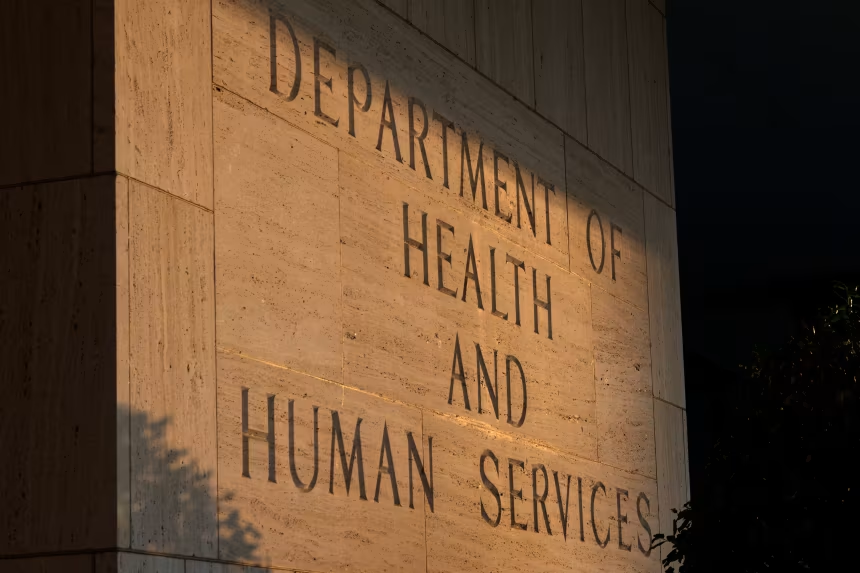
The Trump administration has ordered states to investigate certain individuals enrolled in Medicaid to determine whether they are ineligible because of their immigration status, with five states reporting they’ve received more than 170,000 names collectively — an “unprecedented” step by the federal government that ensnares the state-federal health program in the president’s immigration crackdown.
Advocates say the push burdens states with duplicative verification checks and could lead people to lose coverage just for missing paperwork deadlines.
Only U.S. citizens and some lawfully present immigrants are eligible for Medicaid, which covers low-income and disabled people, and the closely related Children’s Health Insurance Program. Those without legal status are ineligible for federally funded health coverage, including Medicaid, Medicare, and plans through the Affordable Care Act marketplaces.
“We are tightening oversight of enrollment to safeguard taxpayer dollars and guarantee that these vital programs serve only those who are truly eligible under the law,” Health and Human Services Secretary Robert F. Kennedy Jr. said in a press release announcing the verification effort in August.
The release said all 50 states would receive names to check within a month.
To gauge the effort’s progress, KFF Health News in October reached out to Medicaid agencies in 10 randomly selected states. Five provided the approximate number of names they had received from the Trump administration, with expectations of more to come: Colorado had been given about 45,000 names, Ohio 61,000, Pennsylvania 34,000, Texas 28,000, and Utah 8,000. More than 70 million people are enrolled in Medicaid.
Most of those states declined to comment further. The other five — California, Florida, Georgia, New York, and South Carolina — refused to say how many names they were ordered to review or did not respond.
In August, the Centers for Medicare & Medicaid Services began sending states the names of people enrolled in Medicaid that the agency suspected might not be eligible, demanding state Medicaid agencies check their immigration status.
In recent days, Deputy Health and Human Services Secretary Jim O’Neill began posting pictures on the social platform X of people he said are convicted criminals living in the U.S. without authorization who had received Medicaid benefits.
O’Neill could not be reached for comment. CMS spokespeople didn’t respond to a request for comment or confirm how many names the agency has submitted to states.
“We are very concerned because this seems, frankly, to be a waste of state resources and furthers the administration’s anti-immigrant agenda,” said Ben D’Avanzo, senior health advocacy strategist with the National Immigration Law Center, an advocacy group. “This duplicates what states already do,” he said.
As part of the administration’s crackdown on people in the U.S. without authorization, President Donald Trump in February directed federal agencies to take action to ensure they are not obtaining benefits in violation of federal law.
In June, advisers to Kennedy ordered CMS to share information about Medicaid enrollees with the Department of Homeland Security, drawing a lawsuit by some states alarmed that the administration would use the information for its deportation campaign against unauthorized residents.
In August, a federal judge ordered HHS to stop sharing the information with immigration authorities.
State Medicaid agencies use databases maintained by the Social Security Administration and Department of Homeland Security to verify enrollees’ immigration status.
If states need to go back to individuals to reverify their citizenship or immigration status, it could lead some to fall off the rolls unnecessarily — for example, if they don’t see a letter requesting paperwork or fail to meet a deadline to respond.
“I am not sure that evidence suggests there really is a need for this” extra verification, said Marian Jarlenski, a health policy professor at the University of Pittsburgh School of Public Health.
In its August press release, CMS said it’s asking states to verify eligibility for enrollees whose immigration status could not be confirmed via federal databases. “We expect states to take quick action and will monitor progress on a monthly basis,” the agency said.
Leonardo Cuello, a research professor at Georgetown University’s Center for Children and Families, called the CMS order to states “unprecedented” in the Medicaid program’s 60-year history.
He said the federal government may have been unable to verify certain individuals’ immigration status because names were misspelled or outdated, such as when a beneficiary is identified by their maiden instead of married name. The names may also include people helped by Emergency Medicaid, a program that covers the cost of hospital emergency services, including labor and delivery, for people regardless of immigration status.
“CMS is conducting pointless immigration status reviews for people whose hospital bills were paid by Emergency Medicaid,” Cuello said.
The verification checks create an added burden for state Medicaid agencies that are already busy preparing to implement the tax and policy law Trump signed in July. The measure, which Republicans call the One Big Beautiful Bill Act, makes many changes to Medicaid, including adding a work requirement in most states starting by 2027. The law also requires most states to more frequently check the eligibility of many adult Medicaid enrollees — at least twice a year.
“I fear states may do unnecessary checks that create a burden for some enrollees who will lose health coverage who should not,” Cuello said. “It’s going to be a whole lot of work for CMS and states for very little pay dirt.”
Cuello said the effort may have “greater political value than actual value.”
Brandon Cwalina, a spokesperson for the Pennsylvania Department of Human Services, which runs Medicaid in the state, said the state already requires every Medicaid applicant to verify their citizenship or, where applicable, their eligible immigration status.
However, he said, the directive issued by CMS “constitutes a new process, and DHS is carefully reviewing the list in order to take appropriate actions.”
If a lawful resident does not have a Social Security number, the state confirms their legal status by checking a database from Homeland Security, as well as verifying specific immigration documents, he said.
Other state Medicaid agencies said they also needed to regroup before reaching out to enrollees.
“Our teams just received this notice and are working through a process by which we will perform these reviews,” Jennifer Strohecker, then Utah’s Medicaid director, told a state advisory board in August.
Author: Staff Writer | Courtesy of “Forbes” | Edited for WTFwire.com | SOURCE: CNN News
: 178