Trump says Venezuela oil turning over to US

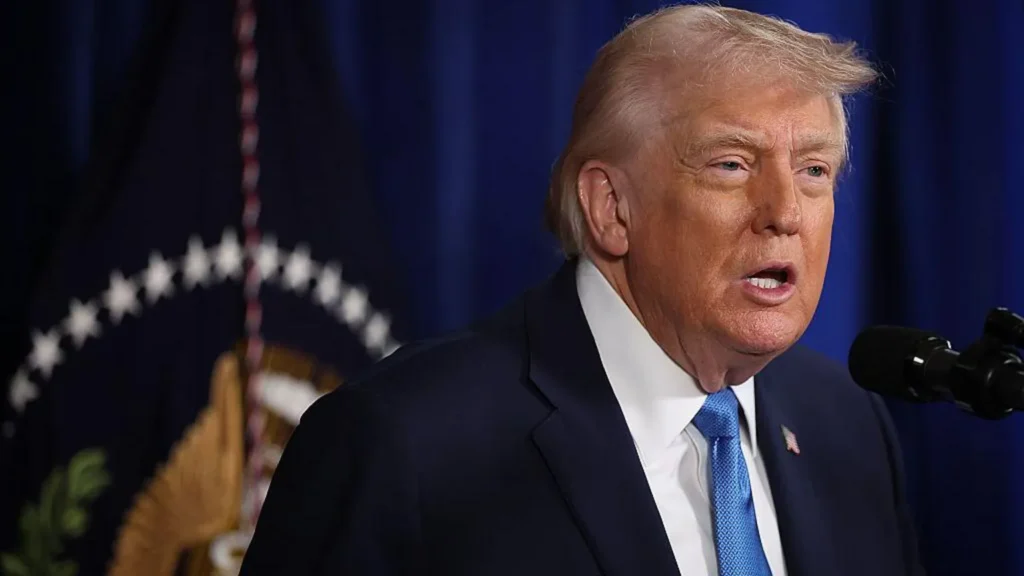
Donald Trump has said Venezuela “will be turning over” up to 50 million barrels of oil to the US, after a military operation to remove President Nicolás Maduro from power.
The oil – worth about $2.8bn (£2.1bn) – will be sold at its market price, the US president wrote on social media, adding he would control the money raised and use it to benefit the people of Venezuela and the US.
His comments come after he said the US oil industry would be “up and running” in Venezuela within 18 months and that he expected huge investments to pour into the country.
Analysts previously told the BBC it could take tens of billions of dollars – and potentially a decade – to restore Venezuela’s former output.
China, which has been the biggest buyer of Venezuelan oil in recent years, has condemned Trump’s announcement as well as the US’s reported demands that Venezuela gives its oil exclusively to them.
ABC News has reported, citing unnamed sources, that Trump had told Venezuela’s interim leader Delcy Rodríguez to agree to an exclusive partnership with the US on oil production and sever economic ties with China, Russia, Iran and Cuba.
Trump posted on Truth Social on Tuesday: “I am pleased to announce that the Interim Authorities in Venezuela will be turning over between 30 and 50 MILLION Barrels of High Quality, Sanctioned Oil, to the United States of America.
“This Oil will be sold at its Market Price, and that money will be controlled by me, as President of the United States of America, to ensure it is used to benefit the people of Venezuela and the United States!”
His comment came a day after Rodríguez, formerly Venezuela’s vice-president, was sworn in as its interim president. Maduro has been brought to the US to face drug-trafficking and weapons charges.
The US president told NBC News on Monday: “Having a Venezuela that’s an oil producer is good for the United States because it keeps the price of oil down.”
Representatives from major US petroleum companies planned to meet the Trump administration this week, the BBC’s US news partner CBS reported.
Analysts who previously spoke to the BBC were sceptical that Trump’s plans would have a major impact on the global supply – and therefore price – of oil.
They suggested that firms would look for reassurance that a stable government was in place – and, even when they did invest, their projects would not deliver for years.
Trump has argued in recent days that US oil companies can fix Venezuela’s oil infrastructure.
The country has an estimated 303 billion barrels – the world’s largest proven reserve – but its oil production has been in decline since the early 2000s.
The Trump administration sees significant potential for its own energy prospects in Venezuela’s reserves.
Increasing the country’s production of oil would be expensive for US firms.
Venezuelan oil is also heavy and more difficult to refine. There is only one US firm, Chevron, currently operating in the country.
Asked for comment about Trump’s plans for US oil production in Venezuela, Chevron spokesman Bill Turenne said the company “remains focused on the safety and wellbeing of our employees, as well as the integrity of our assets”.
“We continue to operate in full compliance with all relevant laws and regulations,” he added.
ConocoPhillips, a major US oil company that no longer has a presence in Venezuela, “is monitoring developments in Venezuela and their potential implications for global energy supply and stability”, said spokesman Dennis Nuss.
“It would be premature to speculate on any future business activities or investments.”
A third company, Exxon, did not immediately respond to requests for comment.
Chinese foreign ministry spokeswoman Mao Ning said on Wednesday that the US’s “blatant military action against Venezuela, and its demand that Venezuela prioritise the US in disposing of its oil resources, is a typical act of bullying, a serious violation of international law, a severe infringement upon Venezuela’s sovereignty, and a grave damage to the rights of the Venezuelan people”.
She added: “I want to emphasise that the legitimate rights and interests of China and other countries in Venezuela must be protected… Co-operation between China and Venezuela is the co-operation between two sovereign states, which is under protection of international law and the domestic laws of the two countries.”
While justifying the seizure of Maduro from Caracas, Trump also claimed that Venezuela “unilaterally seized and stole American oil”.
Vice-President JD Vance echoed those claims on X after Maduro was taken, writing that “Venezuela expropriated American oil property and until recently used that stolen property to get rich and fund their narcoterrorist activities”.
The reality is more complex.
US oil companies have a long history in Venezuela, extracting oil under licence agreements.
Venezuela nationalised its oil industry in 1976, and in 2007, President Hugo Chavez exerted more state control over the remaining foreign-owned assets of US oil firms operating in the country.
In 2019, a World Bank tribunal ordered Venezuela to pay $8.7bn in compensation to ConocoPhillips for the move.
That sum has not been paid by Venezuela, so at least one US oil company has outstanding compensation which is owed to it.
But BBC Verify’s Ben Chu said the claim Venezuela has “stolen” US oil is too simplistic, as experts said the oil itself was never actually owned by anyone except Venezuela.
The ownership of natural resources by sovereign nations is considered a key tenet of international law.
Author: Staff Writer | Edited for WTFwire.com | SOURCE: BBC News
: 151