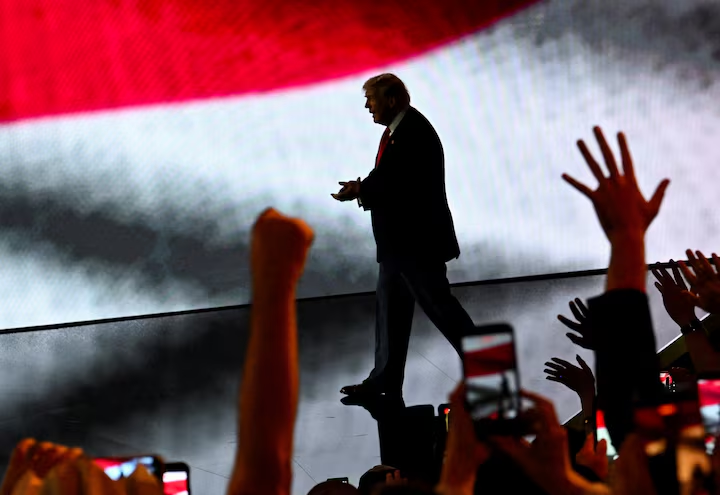
Trump Wants to Leave the Iran War Behind but Has Few Good Options

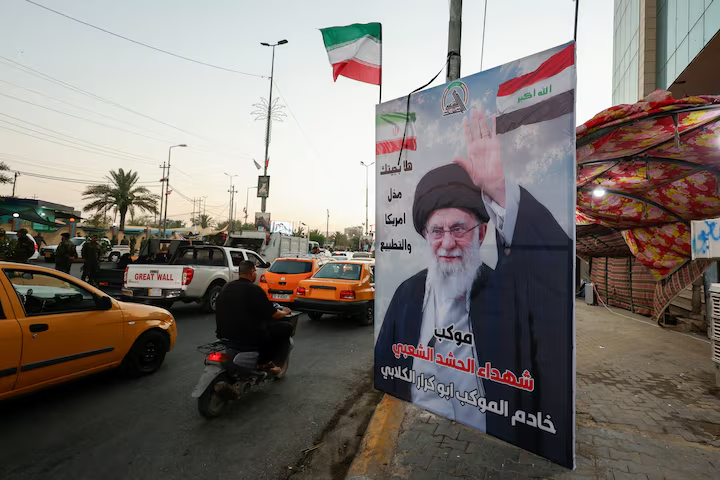
President Donald Trump’s effort to exit the unpopular war with Iran has hit a new wall, with a faltering ceasefire, fresh exchanges of military strikes, and limited diplomatic options leaving analysts skeptical that a lasting settlement is within reach before November’s midterm elections.
Ceasefire Declared “Over,” Strikes Resume
Trump declared an interim agreement to end the conflict “over” Wednesday and ordered new strikes on Iran after Tehran targeted US military installations in Bahrain and Kuwait — itself a response to earlier US bombing of Iranian sites following attacks on tankers in the Strait of Hormuz. The escalation occurred more than three weeks after the signing of a memorandum of understanding intended to begin a truce.
Oil prices spiked roughly 7% following the exchange, adding to the economic and political pressure bearing down on an administration already struggling to contain the war’s domestic fallout.
Trump in a Box With Few Good Options
Analysts say Trump’s choices are mostly bad. Heavy escalation beyond tit-for-tat strikes risks a return to full-scale war — an outcome Trump has sought to avoid. But backing down in the face of Iranian defiance could reinforce Tehran’s calculation that it can exert leverage over the Strait of Hormuz whenever it chooses.
“Trump has put himself in a box,” said Aaron David Miller, a former Middle East negotiator who served both Democratic and Republican administrations. “Whether through military or diplomatic means, he doesn’t look likely to gain much from Iran.”
Trump may be hoping military pressure can push Iran back to the negotiating table on its nuclear program — his stated primary war objective. But most analysts see little sign Tehran is prepared to offer the deep concessions he has demanded.
“The situation is not going to revert to full-scale war,” said Jonathan Panikoff, a former deputy US national intelligence officer for the Middle East now at the Atlantic Council. “But the default setting is now managed instability — recurring violence with no permanent off-ramp.”
Political Pressure Mounts as Midterms Approach
The Iran war has already inflicted significant political damage. A Reuters/Ipsos poll conducted June 23 showed Trump’s approval rating falling to 34% — returning to the lowest level of his second term and dimming Republican prospects for retaining control of Congress in November.
The latest wave of attacks overshadowed this week’s NATO summit in Ankara, which Trump had hoped to use to project strength and alliance unity. High gasoline prices driven by the war remain a persistent drag on consumer confidence and a potential liability with voters.
“Haunted by former US President Hoover’s failed economic stewardship, Trump knows he needs to focus on the economy,” said Laura Blumenfeld, a Middle East expert at Johns Hopkins University, referencing Trump’s own expressed concern that prolonging the war risks making him the president who presided over economic collapse.
Hormuz at the Heart of the Standoff
Underlying the Trump Iran war ceasefire collapse are fundamental disagreements about who controls the Strait of Hormuz, through which roughly one-fifth of the world’s oil once flowed daily before the war disrupted shipments. Iran believes it has a legitimate future role managing the waterway — potentially including the ability to charge fees or tolls. Trump and US Gulf Arab allies insist on a return to free and open passage, which Iran sees as surrendering its most powerful strategic asset.
“The Iranians have judged that Trump doesn’t want to get sucked into an open-ended war, and the Gulf is desperate for normalcy,” said Jon Alterman of the Center for Strategic and International Studies. “Their bet is that Trump will fight for a few days and the Gulf Arab states will push for him to stop.”
Comprehensive Deal Remains Elusive
Most analysts are skeptical the two sides can reach a comprehensive settlement within the 60-day negotiating window laid out in the June 17 memorandum. That document deferred the hardest issues to subsequent talks that have made little progress, and the timing of the next round of discussions remains uncertain.
Iran has absorbed significant economic and military damage from the war, and Washington has now revoked the sanctions waiver allowing Tehran to sell oil internationally — stripping away one of Iran’s main gains under the interim agreement. Even so, Iran’s hardline leadership appears willing to absorb further punishment rather than concede on the Hormuz question. Some analysts suggest this week’s exchanges were partly aimed at staking out negotiating positions for talks yet to come rather than marking a genuine rupture in diplomacy.
Trump, who ran for a second term promising to avoid foreign entanglements and focus on domestic economic concerns, has framed the interim agreement as a major US victory. Tehran has made similar claims. The gap between those competing narratives — and the unresolved dispute over Hormuz — leaves the path to a genuine exit from the war uncertain at best.
Author: Staff Writer | Edited for WTFwire.com | SOURCE: Reuters
: 345