Cyclospora Outbreak Tops 3,000 Cases, Lettuce Suspected as Source

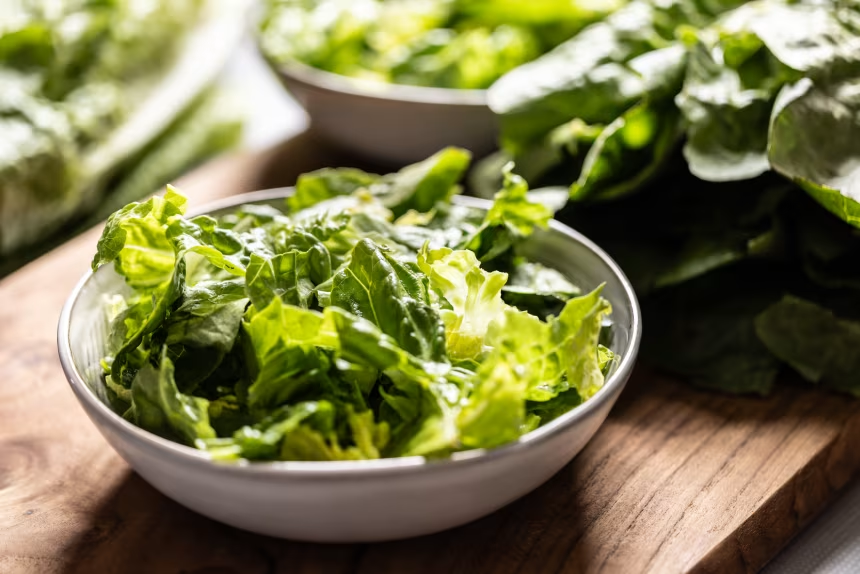
A cyclospora outbreak has surpassed 3,000 cases across Michigan and Ohio, and early investigative signals point to lettuce or salad greens as a possible source — though health officials caution that no specific product, grower, or supplier has been confirmed and other foods cannot be ruled out.
Case Counts Climb as Lettuce Emerges as Lead
Michigan reported 2,640 confirmed cases as of Monday morning, including 44 hospitalizations. Ohio has reported 361 cases since June 1, with at least 46 hospitalizations. Nationally, the CDC has confirmed 843 cases across 31 states since May 1, though its count lags behind state totals as cases undergo further verification.
“Early information has shown lettuce as a common product that regularly comes up during the investigation,” said Dr. Natasha Bagdasarian, Michigan’s chief medical executive. Some restaurants have voluntarily removed fresh ingredients from their menus while the investigation continues, though no nationwide food recall has been issued.
The cyclospora outbreak lettuce Michigan Ohio 2026 investigation is still in early stages. Bagdasarian said investigators are working through more than 2,600 individual interviews — over 1,000 already completed — asking sick individuals to recall what they ate weeks before falling ill. Investigators are also reviewing restaurant receipts, grocery shopper card records, and other purchasing data to identify common food exposures.
Why Cyclospora Is So Difficult to Trace
Pinpointing the source of a cyclospora outbreak takes considerably longer than tracing bacterial illnesses like salmonella or E. coli. Unlike bacteria, cyclospora’s genetic material changes significantly from generation to generation due to sexual reproduction, making DNA fingerprinting — the standard tool for matching sick people to a contaminated food source — far less reliable.
“It’s like reading a children’s book versus reading War and Peace — cyclospora being the War and Peace,” said Jennifer McEntire, a microbiologist and founder of Food Safety Strategies. The parasite also sheds intermittently in stool, meaning patients sometimes require multiple tests before receiving an accurate diagnosis, and it is not included on all standard laboratory workups for stomach illness.
Cases are also widely assumed to be undercounted. Many people who develop the prolonged, debilitating diarrhea caused by cyclospora may wait weeks before seeing a doctor, and by the time a case is confirmed and reported to public health authorities, the exposure that caused it typically occurred weeks earlier — complicating traceback efforts further.
Michigan investigators also noted there is currently no evidence linking the outbreak to recreational water activities such as swimming pools or splash pads.
Surveillance Cuts Hamper the Response
The outbreak is unfolding against a backdrop of weakened federal foodborne illness surveillance. In 2025, amid staff and funding reductions at federal public health agencies, the CDC scaled back its FoodNet surveillance system — a partnership with the USDA, FDA, and 10 state health departments that proactively contacts labs for test results. Before July 2025, FoodNet tracked eight pathogens including cyclospora. It now actively monitors only salmonella and a dangerous strain of E. coli, with others listed as optional.
“I don’t think it’s in our country’s interest to cut these programs back,” former CDC Director Dr. Robert Redfield said Monday. “Surveillance is sort of the key to early identification.”
The Department of Health and Human Services said cyclospora remains a nationally notifiable disease reported through other surveillance systems, and that approximately $33 million is awarded annually to states for foodborne disease tracking activities.
Symptoms, Treatment, and How to Reduce Risk
Cyclospora infection causes watery diarrhea, cramping, and bloating that can persist for weeks. Dehydration severe enough to require hospitalization is common. The standard treatment is a seven-to-ten-day course of the combination antibiotic sulfamethoxazole-trimethoprim, sold under the brand names Bactrim and Septra.
Michigan health officials are advising residents to buy whole heads of lettuce rather than pre-washed bagged salad mixes, discard the outer leaves, and thoroughly wash the remaining leaves under running water. Cooking fruits and vegetables eliminates the parasite entirely.
A full source identification will take additional time given the scale of the outbreak, the weeks-long delay between exposure and confirmed diagnosis, and the complexity of modern food distribution networks, Bagdasarian said.
Author: Staff Writer | Edited for WTFwire.com | SOURCE: CNN News
: 199