Hormuz reopening welcomed as Europe pushes security plan

The Hormuz reopening welcomed by global leaders on Friday offered a rare moment of relief in a conflict that has shaken energy markets—but European officials quickly made clear that reopening the vital oil route is not enough.
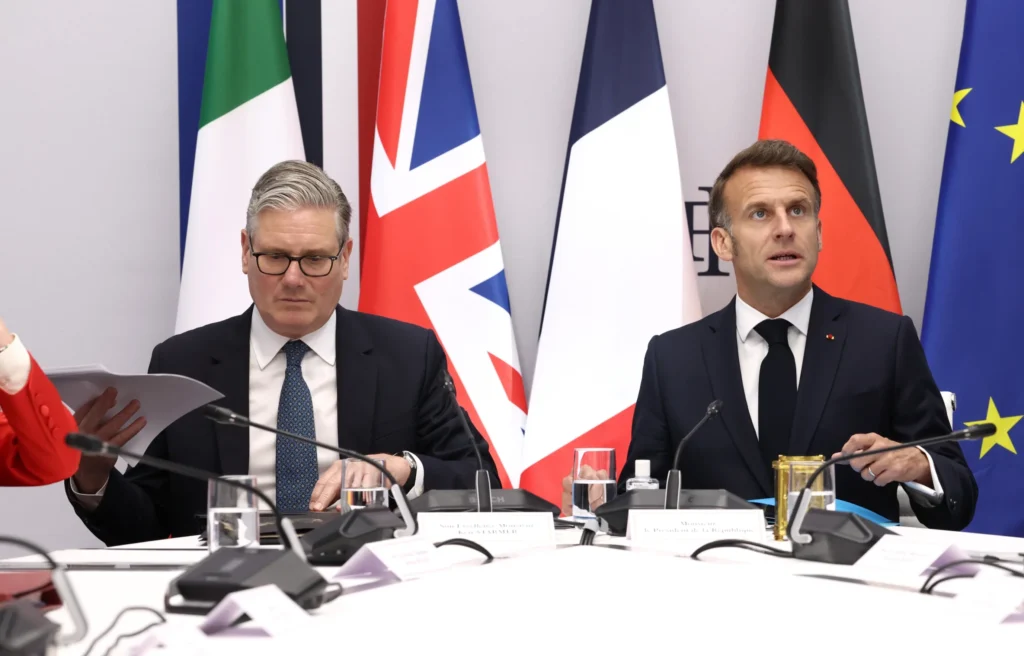
Standing alongside Keir Starmer in Paris, French President Emmanuel Macron called for “full, immediate and unconditional” access through the Strait of Hormuz, warning that anything short of a lasting solution risks renewed disruption.
The announcement that Iran and the United States would allow commercial shipping to resume sent oil prices sharply lower. But the reopening is tied to a fragile, time-limited ceasefire—raising doubts about how long the corridor will remain accessible.
For countries heavily reliant on global trade, that uncertainty is the real concern.
“This has to be lasting and workable,” Starmer said, signaling that short-term fixes will not stabilize markets already rattled by weeks of volatility.
A European-led security push
In response, European leaders are moving ahead with plans for a multinational maritime mission aimed at protecting shipping lanes.
The initiative—deliberately excluding the United States—would focus on defensive operations such as:
- Mine clearance
- Maritime surveillance
- Intelligence sharing
- Limited naval support for commercial vessels
Officials say military planners will meet in London next week to refine the proposal.
Germany’s Friedrich Merz indicated Berlin could contribute technical capabilities, while Italy’s Giorgia Meloni offered naval assets.
A coalition shaped by absence
Notably, Washington is not part of the planning.
That absence reflects both political friction and strategic calculation. While President Donald Trump has pushed allies to take on more responsibility, European officials appear equally motivated to avoid direct overlap with U.S. military operations in the region.
Analysts say that separation could reduce the risk of miscalculation between U.S. and Iranian forces—especially in such a narrow and heavily contested waterway.
Why Hormuz still matters
Even temporarily, the reopening of the strait carries global consequences.
Roughly 20% of the world’s oil supply passes through Hormuz under normal conditions. When Iran effectively closed the route after the war began in late February, prices surged and supply chains were disrupted worldwide.
The latest reopening eases immediate pressure—but does not eliminate the underlying risk.
What comes next
European officials are betting that a coordinated, non-combat mission can help stabilize the corridor without escalating tensions.
Still, key questions remain:
- How long will the ceasefire hold?
- Will Iran and the U.S. maintain open passage?
- Can a multinational force operate without triggering new conflict?
For now, the Hormuz reopening welcomed by leaders is a step forward—but one that depends entirely on what happens next.
Author: Staff Writer | Edited for WTFwire.com | SOURCE: AP News
: 310