US Bans Foreign Humanoid Robots Targeting China Over Security

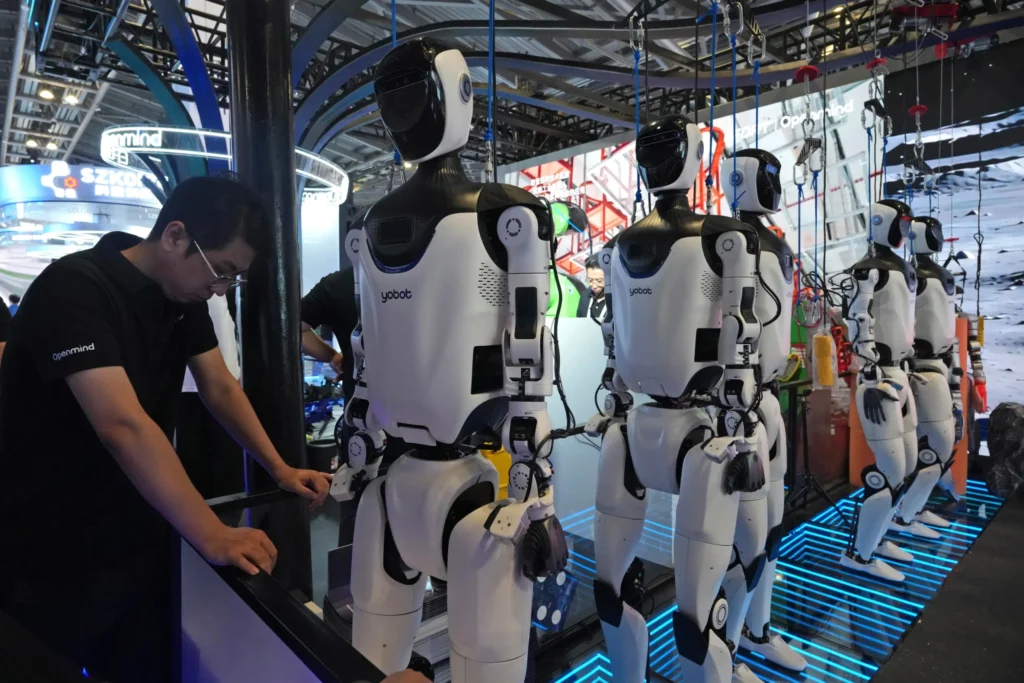
The US Federal Communications Commission has banned imports of new foreign-made humanoid robots, quadruped robots, and power inverters, citing national security and cybersecurity risks — a move that directly targets China, which controls an estimated 85% of the global humanoid robot market. Beijing quickly accused Washington of protectionism.
What the FCC Banned and Why
FCC Chairperson Brendan Carr said the bans are designed to “secure America’s critical supply chains.” The restrictions apply to new versions of humanoid robots, four-legged robot dogs, and power inverters — the latter of which are used to convert electricity in renewable energy systems, data centers, and household appliances. The agency said advanced robotic imports pose cybersecurity and national security risks, and that offshore production of such equipment leaves US supply chains vulnerable to disruption.
The FCC ban appears to apply to new imports only, not to continued use or sales of previously approved models already in the market.
China Dominates the Market Being Restricted
The US ban Chinese humanoid robots power inverters security action comes at a moment when China has a commanding lead in the global robotics race. Of roughly 15,000 humanoid robots shipped globally in 2025, Chinese companies Unitree and AGIBOT each shipped more than 5,000. By comparison, US counterparts including Tesla and Figure AI each shipped a few hundred or fewer, according to technology research firm Omdia.
Morgan Stanley analysts forecast China’s humanoid robot market could reach $15 billion by 2030, supported by government policies backing the country’s technology sector. “Chinese manufacturers have been scaling production and reducing costs faster than most overseas competitors,” said Morningstar analyst Kangyuxiao Li.
Li said the ban removes an important export market for Chinese firms and shields US developers from price competition, but added it “will not materially slow China’s overall humanoid development, given the size of its domestic manufacturing base and opportunities in other export markets.”
Broader Tech Rivalry Ahead of Trump-Xi Summit
The ban is the latest in a series of US restrictions on Chinese technology exports, following earlier curbs on drones and advanced semiconductors. Washington is also weighing restrictions on the use of Chinese open-source AI models at a time when systems like DeepSeek and Moonshot’s Kimi K3 are rapidly gaining ground.
“It’s a steady drumbeat of potential flashpoints heading into the Trump-Xi summit planned for September,” said Samm Sacks, a senior fellow at New America focused on Chinese technology policy.
The restrictions could also complicate existing US-China industry collaborations. Nvidia, for example, revealed in June a humanoid robot reference design that uses the chassis of China’s Unitree. The Pentagon has separately listed Unitree and several other Chinese tech companies on a list of firms it says have ties to the Chinese military — a characterization Beijing has rejected.
China’s Response
China’s Foreign Ministry accused Washington of overstretching the concept of national security to suppress Chinese businesses and warned it would take “all measures necessary” to defend Chinese companies’ interests. “Protectionism does not make the US more competitive, and it will only hurt the interests of US companies and consumers,” said Foreign Ministry spokesperson Mao Ning.
Author: Staff Writer | Edited for WTFwire.com | SOURCE: AP News
: 207