Venezuela Transition Talks Begin Saturday Without Machado

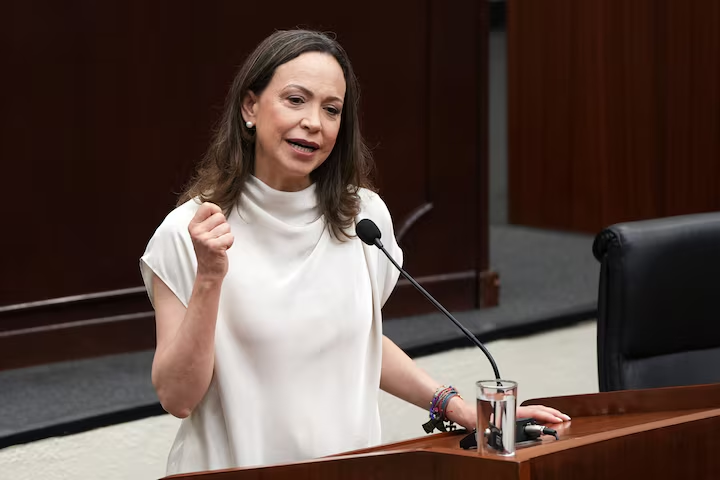
US-backed political negotiations aimed at charting Venezuela’s transition toward new elections are set to begin Saturday, but without the participation of the country’s most prominent opposition leader — Nobel Peace Prize laureate María Corina Machado — leaving the process questioned by her supporters from the outset and distrusted by ruling coalition hardliners in equal measure.
What the Talks Are and Who Is at the Table
The negotiations will bring together Venezuela’s interim government, led by acting President Delcy Rodríguez, and a group of opposition figures from the National Assembly elected in 2015. According to the US State Department, the talks will focus on rebuilding democratic institutions, strengthening electoral participation, and guaranteeing political freedoms.
The Venezuela transition talks Machado US-backed negotiations process was announced in mid-July, when Rodríguez’s administration and the former opposition lawmakers announced a joint work plan described as aimed at “strengthening democracy.” Washington hailed it as an important step toward political reconciliation in a country still reeling from last month’s devastating earthquakes that killed more than 5,000 people.
Machado Refuses to Participate, Calls for Accountability
Machado announced Sunday she had played no role in designing the talks and would not participate. In a statement co-signed by Edmundo González Urrutia — who ran for president in 2024 in her place — she said the opposition would “not participate” in the “design, development and operation” of the process.
“It is not our place to explain its scope and decisions. Those promoting it must inform the country of its objectives, its method, and its timeline,” the statement read.
Machado stopped short of calling for the talks to be abandoned, saying she would not stand in the way “of any initiative that would produce real progress,” and pledging: “We will return to Venezuela.” She and González said they would judge the negotiations by whether they can deliver “concrete, verifiable” results — including the restoration of democratic institutions, the release of political prisoners, and a clear timeline for new presidential elections.
Machado has remained outside Venezuela since departing late last year to accept the Nobel Peace Prize in Oslo. She has repeatedly vowed to return home, particularly following the earthquakes, and recently said she was being blocked from doing so.
Washington Backs the Process, Expresses Hope for Machado’s Inclusion
Secretary of State Marco Rubio, a longtime supporter of Machado, told journalists this month she was welcome to participate if Venezuelans supported her presence at the talks. “In order for Venezuela to have the reconciliation that that country requires to move forward on all these other projects, every element of Venezuelan society needs to be represented. And obviously, Maria Corina represents an important element of that,” Rubio said. He described the US role as one of facilitator, not dictator.
Rubio had called the looming negotiations “a really good development,” while acknowledging their limitations without broad opposition support. One opposition source close to the group led by exiled figure Dinorah Figuera described the US as “a central player” in the talks and said it would not remain on the sidelines. US involvement, another opposition source said, offers security for participants whose members have faced repeated detention and prosecution on charges they describe as politically motivated.
Doubts on Both Sides of the Divide
The absence of Machado — Venezuela’s most recognized opposition figure internationally — has drawn skepticism from her base, which questions whether talks held without her can produce meaningful democratic outcomes. On the other side, hardliners within the ruling coalition have denounced the negotiations outright, distrustful of a process they see as shaped entirely by Washington.
Both camps held protests ahead of the talks. The deep divisions underscore the scale of the political challenge facing Venezuela, which is simultaneously managing the aftermath of its deadliest natural disaster in decades and navigating a US-designed political transition that has not yet secured the support of its most consequential actors.
: 252