Iran Deal Includes $300 Billion Investment Fund as Final Talks Begin


DUBAI — A proposed U.S.-Iran agreement includes plans for a $300 billion private investment fund designed to encourage economic development in Iran, with more than half of the funding already committed, according to a source familiar with the negotiations.
The fund is expected to become a key economic pillar of a broader effort to end the conflict between Washington and Tehran and create incentives for both sides to reach a permanent agreement.
Officials from the United States and Iran announced this week that they had reached a framework agreement aimed at ending hostilities, reopening the Strait of Hormuz and launching a new round of negotiations covering Iran’s nuclear program and regional security issues.
Iran Investment Fund Would Be Privately Financed
According to the source, the proposed Iran investment fund would consist entirely of private-sector capital rather than government funding.
Companies from the United States, Gulf Arab nations, Asia, Africa and South America have reportedly pledged more than $150 billion in commitments so far.
The investment vehicle, expected to be called the Reconstruction and Development Fund, would focus on projects across several sectors, including:
- Energy
- Manufacturing
- Transportation
- Logistics
- Infrastructure
The source emphasized that the fund is not intended to serve as a reconstruction grant program or war reparations package.
Instead, it would operate as a private investment mechanism designed to support economic growth and attract international capital to Iran.
Fund Would Activate Only After Final Agreement
The investment program would not become operational immediately.
Negotiators have structured the current memorandum of understanding as a 60-day framework designed to guide discussions toward a comprehensive agreement.
Only after a final accord is reached would the Iran investment fund officially launch.
During the negotiation period, administrators would work with Iranian officials and potential investors to identify projects and prepare implementation plans.
“It’ll only be created once the final deal is signed,” the source said.
Trump Rejects Claims of U.S. Financial Contribution
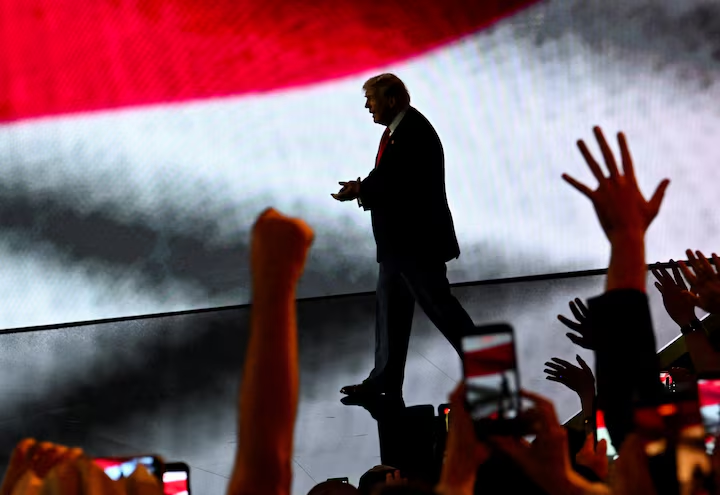
President Donald Trump distanced the United States from any suggestion that Washington would directly finance the initiative.
Speaking on the sidelines of the Group of Seven summit in France, Trump said the United States would not contribute funds to the program.
“We’re not investing, we’re not putting up 10 cents,” Trump said.
He also noted that Gulf nations would likely evaluate Iran’s future behavior before deciding how much additional support to provide.
The White House has pointed to comments made by Vice President JD Vance, who described the fund as a potential reconstruction vehicle backed primarily by Gulf countries if Iran complies with future agreements.
Iran Originally Sought Compensation
A senior Iranian source said Tehran initially requested approximately $400 billion in compensation for damages caused during the conflict.
According to the source, U.S. negotiators rejected direct compensation payments.
The proposed investment fund subsequently emerged as an alternative mechanism that could channel large-scale capital into Iran without requiring direct government transfers.
Regional countries may participate by financing infrastructure projects, establishing credit facilities or guaranteeing loans.
Potential projects reportedly include:
- Refineries
- Airports
- Transportation networks
- Industrial facilities
- Energy infrastructure
Among the sites identified for future development is the Mobarakeh Steel complex, one of Iran’s largest industrial operations.
Iran Seeks to Attract Foreign Capital
For decades, Iran has struggled to attract significant foreign direct investment due to sanctions and political tensions with Western countries.
Despite those challenges, the country possesses substantial economic potential.
Iran holds the world’s fourth-largest proven oil reserves and the second-largest natural gas reserves. It also has a population of more than 92 million people and a diverse industrial base.
Analysts have long argued that sectors such as mining, petrochemicals, tourism, agriculture and manufacturing could attract major international investment if restrictions are eased.
The proposed Iran investment fund is intended to capitalize on those opportunities.
Separate From Sanctions Relief Talks
The investment initiative remains separate from ongoing discussions over sanctions relief and frozen Iranian assets.
According to the source, those negotiations are being conducted through different channels and involve separate timelines.
While sanctions relief may eventually become part of a broader agreement, the investment fund is structured independently and would focus exclusively on commercial development opportunities.
Major Issues Remain Unresolved
Despite progress toward a framework agreement, several critical issues remain unresolved.
Negotiators must still reach consensus on:
- Iran’s nuclear program
- Sanctions removal
- Regional security arrangements
- Verification and inspection mechanisms
- Long-term economic cooperation
The current memorandum serves as a roadmap rather than a final agreement.
Officials from both countries are expected to spend the next 60 days negotiating detailed terms before any final accord can be signed.
If successful, the agreement could represent one of the most significant diplomatic and economic openings between the United States and Iran in decades.
For now, however, the proposed Iran investment fund remains contingent on a comprehensive peace agreement being completed and approved by both sides.
Author: Staff Writer | Edited for WTFwire.com | SOURCE: Reuters
: 189