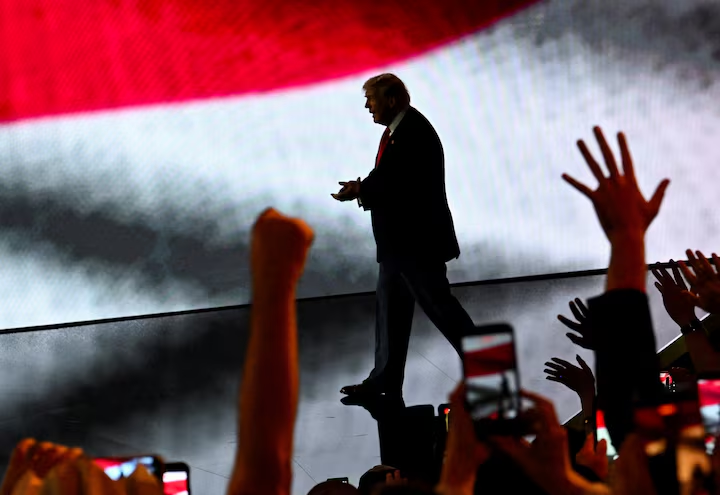
Trump Heads to NATO Summit in Ankara to Enforce Defense Spending Pledges


President Donald Trump departed Monday evening for Ankara, Turkey, where he will press NATO allies to follow through on the sweeping defense spending commitments he secured at last year’s summit — while navigating a crowded agenda that includes the war in Ukraine, the Iran ceasefire, and a web of strained personal relationships with European leaders.
From Demanding Pledges to Enforcing Them
At last year’s NATO summit in The Hague, Trump extracted a landmark commitment from allies to spend 5% of their GDP on defense over the next decade — 3.5% on core military expenditure and the remainder on related investments such as infrastructure. The speed with which most NATO members have moved to accommodate that demand underscores the degree to which Trump has reshaped the alliance since returning to office.
“President Trump fully expects that all allies will step up immediately and get on the path to 5% and do it with urgency,” said Matt Whitaker, the US ambassador to NATO, previewing the administration’s message ahead of the summit. Luke Coffey, a senior fellow at the Hudson Institute, described the Ankara gathering as the “first report card” following The Hague commitments, noting that if allies demonstrate credible plans to meet their targets, “it’ll allow President Trump to take a victory lap.”
NATO Secretary General Mark Rutte sought to prime that dynamic last month during an Oval Office meeting, displaying large charts on easels showing what he called “The Trump Trillion” — the cumulative increase in allied defense spending since 2017. Despite those efforts, Trump spent days before his departure airing public grievances about the disparity between US and European defense expenditure.
Ukraine and Key Bilateral Meetings on the Agenda
The war in Ukraine, now entering its fifth year, is expected to be a central focus of the summit’s substantive discussions. The White House confirmed that Trump will meet with Ukrainian President Volodymyr Zelenskyy on Wednesday. Trump spoke separately with both Zelenskyy and Russian President Vladimir Putin on July 4.
Trump also plans a meeting with Syrian President Ahmad al-Sharaa on the summit sidelines, amid public speculation from Trump about Syria playing a larger role in countering Hezbollah in Lebanon — a suggestion al-Sharaa has publicly rejected. A bilateral meeting with Turkish President Recep Tayyip Erdogan, the summit’s host and a leader Trump regards as a close ally, is also scheduled. No bilateral meetings with other European leaders are currently planned.
Transatlantic Tensions Simmer Beneath the Surface
Despite a relatively positive G7 summit last month in France, Trump quickly resumed feuding with European counterparts upon returning to Washington. He publicly declared that British Prime Minister Keir Starmer would resign before Starmer made the announcement himself, and claimed Italian Prime Minister Giorgia Meloni had begged him for a photo — a charge Meloni vigorously denied, which prompted Italy to cancel a scheduled US visit by its foreign minister. Trump continued stoking the dispute over the weekend, posting a photo of Meloni smiling at him with the caption “RESTRAINING ORDER NEEDED.”
Relations with Canadian Prime Minister Mark Carney remain tense, and while French President Emmanuel Macron hosted Trump at a lavish Versailles dinner last month, the two leaders’ rapport has been inconsistent.
Aware of those frictions, a bipartisan group of US senators is again traveling to Ankara — as they did to The Hague — to signal Congressional support for the alliance and provide a counterweight to Trump’s often adversarial posture toward NATO partners. “They are our best allies, they are our best trading partners, they are critical to our national security,” said Senator Jeanne Shaheen, D-N.H., who is leading the delegation.
Pushing for “NATO 3.0”
The NATO Ankara summit Trump agenda also includes a broader strategic vision. Trump’s administration has been promoting what it calls “NATO 3.0” — a reconfigured alliance in which Europe assumes greater responsibility for its own conventional defense, freeing the United States to redirect military attention elsewhere.
The concept was outlined earlier this year by Elbridge Colby, US undersecretary of defense. Defense Secretary Pete Hegseth reinforced the message at a NATO defense ministers’ meeting last month, announcing a six-month review of the US military presence in Europe — a move that caught many allies off guard. Trump added to the confusion earlier this year by announcing the deployment of 5,000 US troops to Poland just weeks after ordering an equivalent withdrawal from the continent.
Senator Shaheen said the NATO 3.0 framework “fails to understand — as this administration has consistently failed to understand — the threat that Putin and Russia pose to Europe and subsequently to the United States.”
Europe Spends More but Remains Dependent on the US
Despite record increases in European defense budgets — NATO’s European members and Canada spent $90 billion more on defense in 2025 than the previous year — experts caution that most of the continent would still be unable to defend itself without US support in the event of a major attack. “This is the reality for most Europeans,” said Liana Fix, senior fellow for Europe at the Council on Foreign Relations. “Even if they’re starting to develop all that,” she said, they remain far from self-sufficient.
The alliance has also moved to accommodate Trump’s fixation on the Arctic and Greenland. NATO introduced “Arctic Sentry” earlier this year, a military exercise designed to counter Russian and Chinese activities in the region — and implicitly address Trump’s repeated assertions that the United States needs to acquire Greenland from Denmark for strategic security reasons.
Author: Staff Writer | Edited for WTFwire.com | SOURCE: AP News
: 294