Hormuz Shipping Stays Minimal as Peace Talks Raise Cautious Hopes

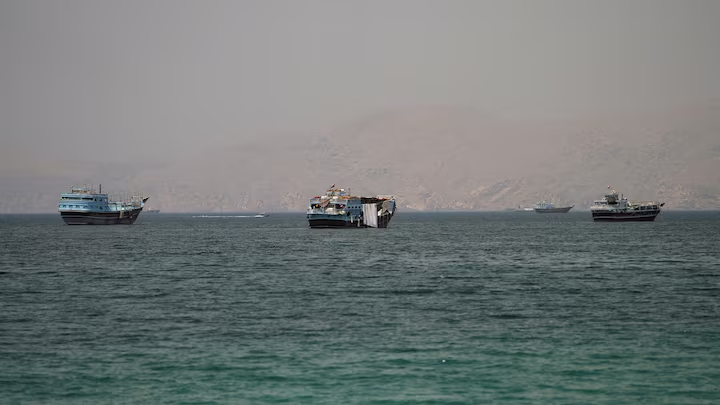
Shipping traffic through the Strait of Hormuz remained at a fraction of prewar levels on Tuesday, data from maritime intelligence firm Kpler showed, even as diplomatic signals from Washington and mediating Gulf states fueled the strongest hopes yet that an agreement to reopen the critical waterway could be reached within days.
Eight Ships Versus 130: The Scale of the Disruption
Eight vessels transited the Strait of Hormuz on Tuesday — five tankers and three bulk carriers — matching the previous day’s count but representing just 6% of the 130 to 140 ships that would typically cross the waterway daily before the US-Israeli war with Iran began on February 28. Of the eight vessels, six were entering the Persian Gulf while a gas carrier and a tanker were exiting.
The Strait of Hormuz shipping traffic peace talks August 2026 picture underscores how thoroughly the conflict has disrupted the world’s most important energy shipping route. In the days before the war, approximately 20 million barrels of oil per day — about one-fifth of global supply — transited the strait. Those flows have been reduced to a trickle since Iran closed the waterway in response to US and Israeli strikes on February 28 and has repeatedly attacked commercial vessels attempting to use routes other than its own designated corridor.
ADNOC LNG Tanker Makes Rare Exit
One notable movement Tuesday was the reappearance of a liquefied natural gas tanker controlled by Abu Dhabi National Oil Co outside the strait, carrying a cargo loaded from Das Island in the Persian Gulf. Ship-tracking data from both Kpler and LSEG showed the vessel — the Mubaraz — off the western coast of India, with a projected discharge at India’s Dahej terminal in Gujarat. This was the third time the Mubaraz has successfully exited the strait carrying cargoes from Das Island since the war began, with the previous two deliveries going to China and India.
ADNOC did not immediately respond to a request for comment outside business hours.
Bab el-Mandeb Traffic Also Steady
In the Bab el-Mandeb strait — the second major energy shipping chokepoint at the mouth of the Red Sea between Yemen and Djibouti — 20 vessels crossed on Tuesday, with 10 entering and 10 exiting the waterway, matching the previous day’s count according to Kpler data. Six tankers, three dry bulk carriers, and a gas carrier were among those transiting.
The Houthis in Yemen have declared a blockade on Saudi-linked shipping through Bab el-Mandeb, raising fears of simultaneous disruption to both chokepoints. However, traffic through the Red Sea route has remained more resilient than through Hormuz, with several Gulf states rerouting energy shipments via Bab el-Mandeb and the Suez Canal rather than through the fully closed Persian Gulf corridor.
Qatar Says Mediators Making Progress
Qatar said Tuesday that mediators were making progress in efforts to end the US-Iran war, helping drive oil prices lower even as Tehran denied Trump’s assertion that formal talks were already underway. Iran’s Foreign Ministry said its focus was solely on negotiations with Oman about a new Hormuz shipping route — separate from any direct engagement with Washington.
Saudi Aramco CEO has warned that even a full reopening of the Strait of Hormuz today would take up to 18 months to fully replenish depleted global oil inventories — a reminder that a diplomatic breakthrough, if it comes, will not immediately normalize energy markets.
Author: Staff Writer | Edited for WTFwire.com | SOURCE: Reuters
: 413