Vaccine Mandates Under Fire as Trump Order Targets States

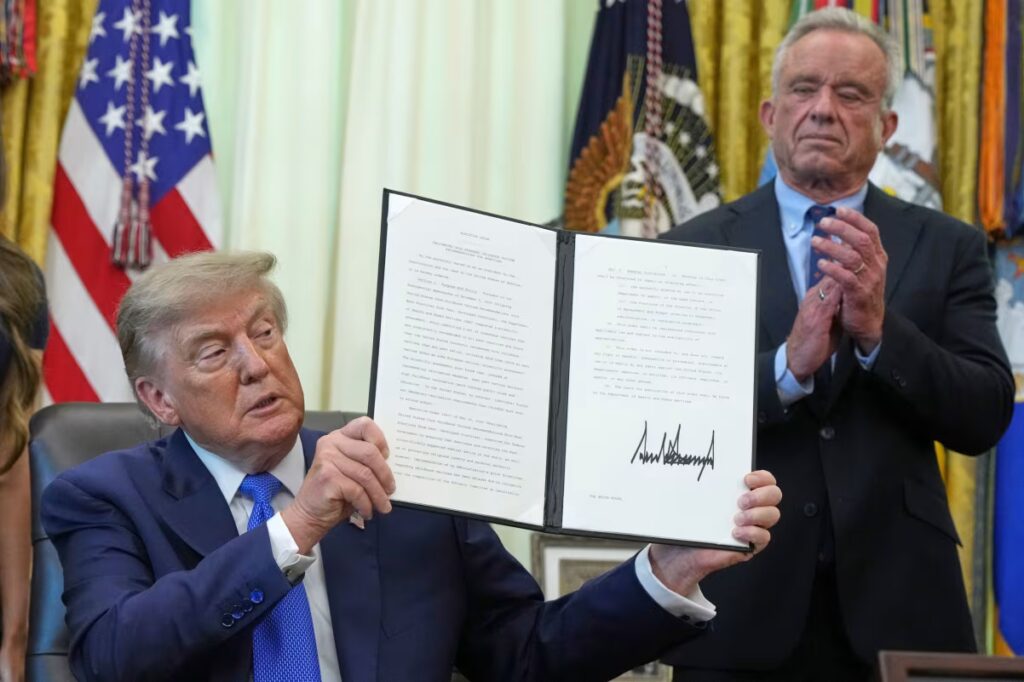
Vaccine mandates across U.S. states are facing new pressure, after a record share of kindergartners had an exemption from a required shot last school year, just as the Trump administration moves to reduce the number of vaccines recommended for children.
An order aimed at state policy
President Donald Trump signed an executive order last week designed to reshape the federal government’s approach to vaccines. The order calls for giving parents “more information and options,” but the authority to set and enforce vaccine requirements still rests with the states, and a growing number are leaning on existing exemption policies.
The administration has signaled it will push states to rework their requirements around new federal guidelines, a move that would upend longstanding efforts to raise childhood immunization rates. Officials have not detailed exactly how they’ll enforce this, but the Department of Justice, the Department of Education and the Department of Health and Human Services have been directed to tie compliance to federal funding.
The order emphasizes a goal of letting parents “maximize” their choices over children’s vaccinations and specifically calls on states to “provide religious and medical exemptions.”
Exemptions hit a record share
All 50 states require certain vaccines for school attendance and allow medical exemptions. Most states also permit exemptions for non-medical reasons, categorized as religious or personal.
CDC data published Monday shows 4.2% of kindergartners had an exemption for at least one required vaccine during the 2025-26 school year — the highest share on record and double what it was a decade ago. That left about 157,000 schoolchildren without full coverage for a state-mandated vaccine, nearly 20,000 more than the previous year. Only 0.2% of exemptions were for medical reasons, a share that has held steady for years.
Exemptions rose in all but nine states, and nearly half of all states now report rates above 5%, the CDC said.
Few states bar non-medical exemptions
Only four states — California, Connecticut, Maine and New York — bar exemptions that aren’t for medical reasons, according to the National Conference of State Legislatures. New York eliminated its religious exemption in 2019 after measles outbreaks there grew into some of the largest the U.S. had seen in decades.
The new CDC data shows MMR vaccination coverage among kindergartners slipped slightly, from 92.5% to 92.4% — still well short of the 95% threshold needed for herd immunity.
State authority over vaccine policy has faced legal challenges before but has been broadly upheld by the U.S. Supreme Court.
States push back on the federal order
Many states, including some that already follow federal guidance and others that have broken from it, say the new order requires no changes at the state level. “Federal recommendations do not change the requirements in Texas,” the state health department said in an email to CNN.
Others reaffirmed their commitment to science-based vaccine policy. “Vaccines are our most effective defense against vaccine-preventable illnesses,” said Dr. Puthiery Va, director of the Maine Center for Disease Control and Prevention. “Maine’s school and child care immunization requirements remain unchanged by federal actions to date.”
Changing state exemption laws requires action by state legislatures, many of which won’t meet again until January. Courts have also intervened: Mississippi began allowing religious exemptions in 2023 after a federal court order, and a similar push in West Virginia is facing legal challenges. Both states previously had some of the strictest vaccine laws and highest childhood coverage rates in the country.
Measles cases climb as trust erodes
Public health experts say rebuilding trust in vaccines is key to reversing the decline in childhood immunization. “If more and more parents choose not to vaccinate their children for non-medical reasons, we will no doubt see a rise in disease outbreaks,” said Dr. William Moss, an associate professor at Johns Hopkins Bloomberg School of Public Health.
Measles cases in the U.S. have reached a 35-year high this year, with the vast majority of cases among people who were not vaccinated with MMR. Even so, the new executive order recommends splitting the MMR vaccine into three individual shots — a change that breaks from broad scientific consensus.
States have historically aligned their vaccine policies with CDC recommendations and guidance from its Advisory Committee on Immunization Practices. But sweeping changes to that panel under Health and Human Services Secretary Robert F. Kennedy Jr., including a reduced disease schedule for routine childhood vaccines, have pushed many states to break from that practice. According to KFF, 28 states have said they will no longer follow federal vaccine recommendations, with most turning instead to guidance from the American Academy of Pediatrics.
“For decades, the U.S. childhood immunization schedule was developed through a rigorous scientific process required by law that evaluates the safety and effectiveness of vaccines and how they should be given to patients,” the Governors Public Health Alliance, a coalition of more than a dozen governors representing about a third of the U.S. population, said in a statement. “President Trump’s Executive Order directing changes to longstanding federal vaccine recommendations circumvents that process and defies scientific consensus. It also risks causing confusion and endangering our children.”
The alliance added that vaccines currently available in the U.S. remain available regardless of the order, and that governors and state health leaders will keep working with providers, schools and local health agencies “to ensure that parents have access to trusted information and can make informed decisions regarding the health of their children.”
Author: Staff Writer | Edited for WTFwire.com | SOURCE: CNN News
: 208