Progressive Democrats Invoke Faith in Fight Against Inequality

The jokes practically wrote themselves as an eclectic group of progressive pastors, imams, and a rabbi filed into a Detroit meeting room. But beneath the levity, the conversation was serious — and urgent.
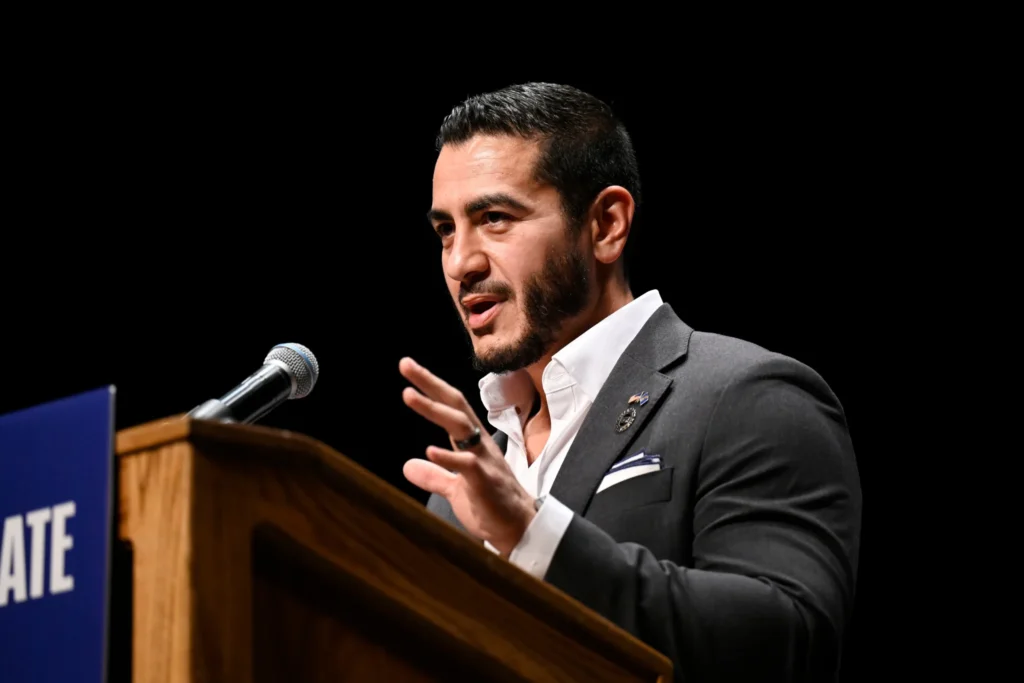
Abdul El-Sayed, the public health researcher running as a Democrat for Michigan’s US Senate seat, opened by asking the interfaith gathering what it means to hold yourself accountable to something greater than yourself. “If you can’t eat food and I have something to do about it, I better do it,” he said.
Faith as Political Fuel
Progressive Democrats have scored a string of electoral victories in recent months, riding voter frustration over inequality, affordability, and the threat artificial intelligence poses to job security. As the economy becomes the defining issue of November’s midterm elections, a growing number of progressive candidates and their supporters are drawing directly on religious tradition to justify their economic platforms.
“We’re in an era of historical inequality,” El-Sayed told the Associated Press. “Most faith traditions — certainly the Abrahamic faith traditions — put a lot more burden on the wealthy.”
El-Sayed’s interfaith roundtable came days after a high-profile rally that featured Senator Bernie Sanders of Vermont and Representative Alexandria Ocasio-Cortez of New York. He is running on Medicare for All and making inequality his central theme, in a Democratic primary against the more moderate Representative Haley Stevens. If elected in November, he would become the first Muslim senator in US history.
A Long Tradition, Renewed for a New Era
Religious support for progressive economic movements has deep roots in American history — from the labor activism of the early 20th century to the civil rights movement. Pope Leo XIV’s recent encyclical echoed the spirit of Pope Leo XIII’s landmark 1891 text on labor and wages that helped shape Catholic social teaching.
The Rev. Andrew Wilkes, who co-pastors the Double Love Experience Church in New York City, said his path to democratic socialism began when he presided over a funeral for someone whose insurance refused to cover a critical operation. “It was not God that sent him home but an unjustly organized healthcare system and economy,” he said. “There’s an increasing recognition connecting socialism to a sense of a moral compass.”
Republicans Push Back
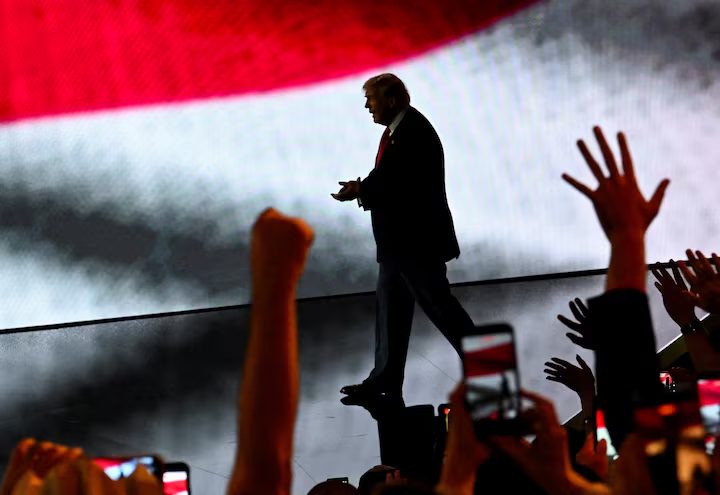
The progressive Democrats faith inequality midterms 2026 alignment has drawn sharp responses from the right. President Donald Trump recently told the Faith & Freedom Coalition that progressive candidates are “hard core, godless communists. All communists are godless. They don’t believe in God.”
Douglas Blair, a spokesperson for Heritage Action for America, offered a more measured version of the same argument. “Republicans and conservatives believe in natural rights that flow from a creator. I think communism rejects that. It espouses a very atheistic, centralized sort of secular view of society,” he said.
Socialism and Religion: Untangling the Contradiction
For many on the progressive left, the accusation that socialism is inherently anti-religious is a Cold War relic that younger voters no longer accept. Megan Romer, a DSA national co-chair and ordained ruling elder in the Presbyterian Church, acknowledged the concern directly. “People’s idea of it is, ‘Oh, that’s when you’re not allowed to have a religion, right?’ Which has been true in some socialist projects,” she said. But she described her own faith tradition as communal rather than individualistic, drawing on early Christian practices.
Many progressive faith activists point to Black religious figures who were outspoken critics of capitalism — including Martin Luther King Jr., Malcolm X, and W.E.B. Du Bois — as models for thinking about the relationship between religion and economic justice.
Attitudes Toward Capitalism Are Shifting
The broader cultural backdrop reinforces the progressive message. About half of US adults now view capitalism positively, according to Gallup — down from 61% in 2010. The decline has been driven primarily by Democrats but has also spread among independents.
At Live Oak United Church of Christ in Brea, California, a grocery store worker named Luis Cueva recently asked congregation members for support in a unionization effort after a Sunday service. “Jesus was a socialist,” Cueva said, citing Christ’s teachings about the difficulty for wealthy people to enter heaven. “It means a lot to know that the church is willing to help.”
El-Sayed on Faith and Politics
El-Sayed, the son of Egyptian immigrants, is aware his Muslim faith can be weaponized or misunderstood. But he described his religious convictions as inseparable from his public positions. “If you put your morals on a mantel, they’re not morals. They’re just things that you can admire and then you give yourself permission to step away from them when it’s convenient,” he said.
As the roundtable concluded in Detroit, faith leaders from each tradition took turns praying. When they finished, the Rev. Horace Sheffield asked for one more moment. “I don’t think y’all were specific enough,” he said. “Lord, let him win.”
Author: Staff Writer | Edited for WTFwire.com | SOURCE: AP News
: 150