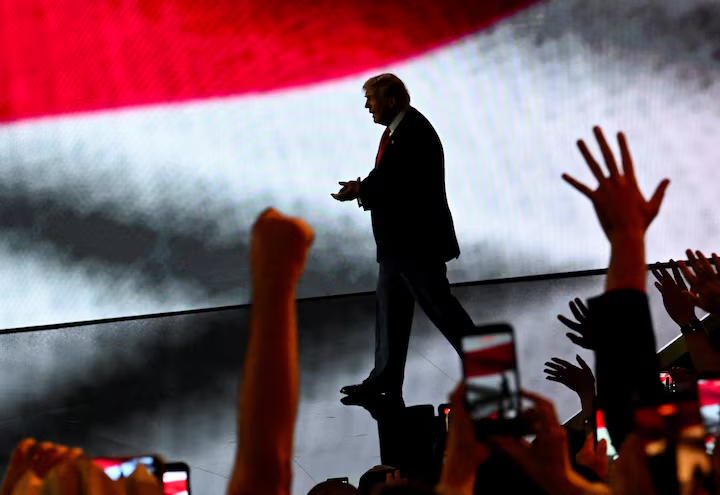
Trump Rings Wall Street Opening Bell to Promote Trump Accounts


President Donald Trump rang the opening bells for the New York Stock Exchange and the Nasdaq from the Oval Office on Monday, a carefully staged act that underscores how deeply he has linked his political identity to stock market performance — even as high inflation continues to weigh on his public approval.
Bell Ringing Marks Launch of Trump Accounts
The ceremony was designed to spotlight the launch of Trump Accounts, a new investment vehicle created as part of Republicans’ sweeping 2025 tax and spending cuts legislation. The program provides children with $1,000 in government seed money to invest in stock indexes, with the stated goal of giving future generations a greater stake in the US economy.
“It’s going to go up — I think the market’s going to go through the roof,” Trump said after formally opening trading.
Treasury Secretary Scott Bessent, who spoke before the bell ringing, framed the initiative as a response to a persistent gap in stock market participation. “38% of American families do not have any exposure to our great equity markets,” Bessent said, arguing that Trump Accounts Wall Street investment could help broaden economic opportunity.
Billionaires Pledge Billions to Seed the Accounts
The accounts have already attracted significant private-sector support beyond the government’s $1,000 contribution. Michael Dell, founder of Dell Technologies, and his wife Susan appeared alongside Trump at the Oval Office event, having pledged $6.25 billion to the program. Separate pledges have come from investor Ray Dalio and SpaceX President Gwynne Shotwell, who announced Monday that she would donate SpaceX stock to the accounts. Trump acknowledged with a joke that the delayed launch meant children had missed out on some of the year’s gains. “We should have acted faster,” he said.
A Political Bet on Stock Market Growth
The event reflects Trump’s broader strategy of tying his presidency’s success to Wall Street performance ahead of November’s midterm elections, which will determine control of Congress. Only 33% of US adults approve of Trump’s economic leadership, according to a June survey by the AP-NORC Center for Public Affairs Research, with high inflation the primary drag on his numbers.
Trump won the 2024 election partly by promising to reduce the cost of living, but his tariff policies and the start of the war with Iran introduced new inflationary pressures. The consumer price index has risen 4.2% over the past 12 months, up from 3% at the start of his second term in January 2025.
The S&P 500 gained 17.9% in 2025 and has risen roughly 10% so far this year — though the two prior years of 25% and 26.3% gains occurred during Democrat Joe Biden’s presidency, a fact that complicates Trump’s attempt to claim credit for the market’s overall trajectory.
Millions of Americans Don’t Benefit From Stock Gains
Economists and critics have noted the limits of Trump’s stock market messaging as a political strategy. Because a large share of equity market gains flows to wealthier households — and because retirement account benefits are decades away for most working Americans — stock index performance is a distant abstraction for many of the voters Trump needs to win over this fall. Trump Accounts are designed in part to address that disconnect, but the program is only just launching and its political impact will not be felt immediately.
Author: Staff Writer | Edited for WTFwire.com | SOURCE: AP News
: 230