Venezuela Earthquake: Families Left Alone to Recover Their Dead

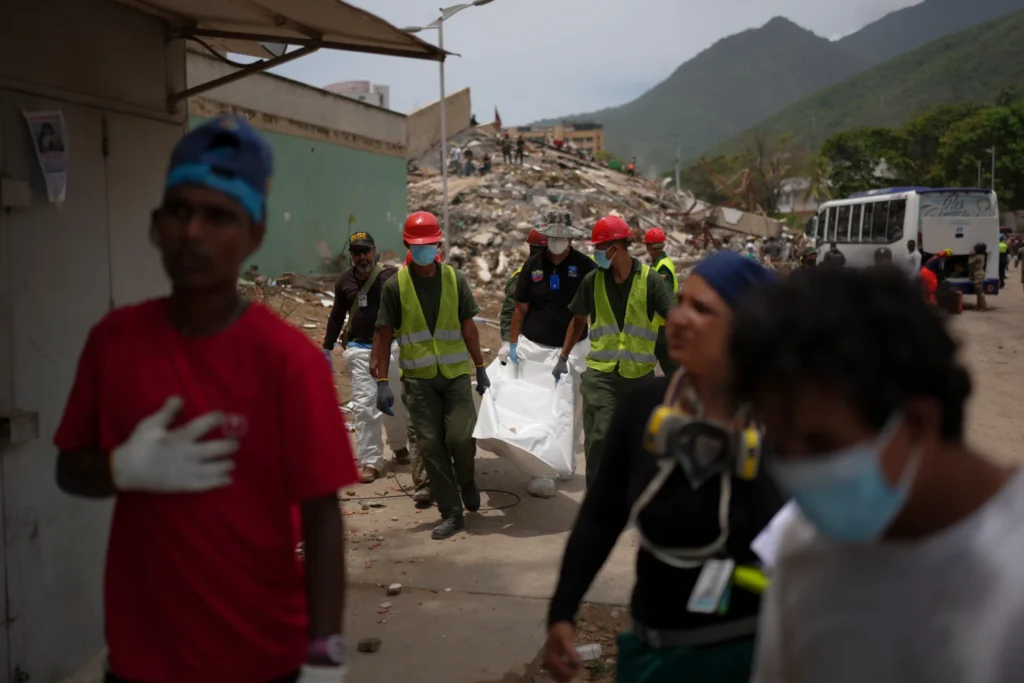
Twelve days after twin earthquakes devastated northern Venezuela, international rescue teams are preparing to leave and local authorities have shifted focus to reconstruction — leaving families to search for their dead with little more than bare hands, pickaxes, and shovels, and no meaningful government support.
A Brother’s Final Cries, Left Unanswered
Noel Márquez was at his girlfriend’s apartment when the high-rise where his family lived collapsed and burst into flames during the June 24 earthquakes. He raced home and called out for his mother, grandparents, and siblings. Only his 17-year-old brother Leonel responded, his legs pinned under concrete columns that would require heavy machinery to remove.
Márquez and his father spoke with Leonel through layers of rubble for hours, listening as he shouted for help and inhaled smoke while they waited for a crane that never came. Eventually, Leonel’s cries went silent.
What disturbed Márquez most was not his brother’s death, but what came after. With no equipment available, he used a saw to free the corpses of Leonel and his mother — but was forced to abandon his eight-months-pregnant sister, his grandmother, and other relatives beneath the ruins, losing with them any hope of a proper burial.
“It’s unfair. It’s inhumane, everything that is happening,” said Márquez, 26, speaking from the overflowing makeshift morgue at La Guaira port. “We couldn’t get my brother out because we didn’t get a response from the state — and after 11 days, we are still requesting a crane.”
International Teams Leave, Families Dig On
International search and rescue teams from Italy, Argentina, Spain, and other countries have already returned home. The remaining operations are being conducted largely by Mexican rescuers and local firefighters, working alongside civilians. Over the weekend in La Guaira, no government civil defense crews or security forces were observed helping families dig through the wreckage. The vast majority of those searching were relatives using rudimentary tools or their bare hands.
“We are the ones helping ourselves — our family. Nobody else helps us except for a few volunteers,” said Yeikhary Urbina, who found the bodies of her mother and brother on Saturday, seemingly locked in an embrace beneath piles of concrete.
The Venezuelan government has not officially called off the search for survivors, but officials have pivoted from promoting rescue stories on state media to announcing reconstruction plans under a program called Venezuela Reborn. “Venezuela is entering a process of infrastructure recovery, of housing recovery,” acting President Delcy Rodríguez said on state television Saturday.
Death Toll Rises, Thousands Still Missing
Authorities announced Sunday that the official death toll has risen to 3,342, with another 16,740 people injured. The true toll is believed to be far higher. No official statistics exist on how many bodies remain buried in the rubble, but more than 30,000 missing person reports have been submitted to a website established by the Venezuelan political opposition.
The recovery process is becoming increasingly harrowing as time passes. “It has been difficult because the bodies are already in an advanced state of decomposition — decomposed to such an extent that many times when we try to remove them, they fall apart,” said William Gomez, a La Guaira firefighter.
“I found her hand, but her torso is crushed,” said Norely Rodríguez, trying to extract her five-year-old daughter from the rubble. “I want to see if I can get her out whole.”
Anger Mounts Over Negligence, Past and Present
For many residents of Venezuela’s public housing towers — built for low-income families under former socialist leader Hugo Chávez — the earthquake has reignited long-standing concerns about substandard construction. Several high-rise residential complexes collapsed entirely during the quakes, and residents say government officials ignored their warnings about structural deficiencies for years.
Alexander, a 42-year-old police officer who lived in one of the towers, trembled with fury recounting the government’s failures: ignoring residents’ pre-earthquake complaints about the building’s construction, failing to send rescue teams in time to save his wife and three daughters, and refusing to send heavy machinery to help retrieve their bodies afterward. He asked to be identified only by his first name, fearing retaliation as a government employee.
After 11 days of searching, he finally reached the last member of his family — his 12-year-old daughter. Her body was decomposed but intact.
“She was waiting for me to pull her out,” he said, cradling the black plastic body bag in his arms.
Geraldine Perdomo described her sister feverishly clawing at the ruins of her home, searching for any trace of her two daughters. “She kept asking, ‘Why did God play this trick on me?'”
For Márquez, the search continues. His mother and grandfather were located by authorities on Sunday — a week after he delivered their bodies to the makeshift morgue. But Leonel, he said, “is still missing because of the negligence here.”
Author: Staff Writer | Edited for WTFwire.com | SOURCE: AP News
: 185