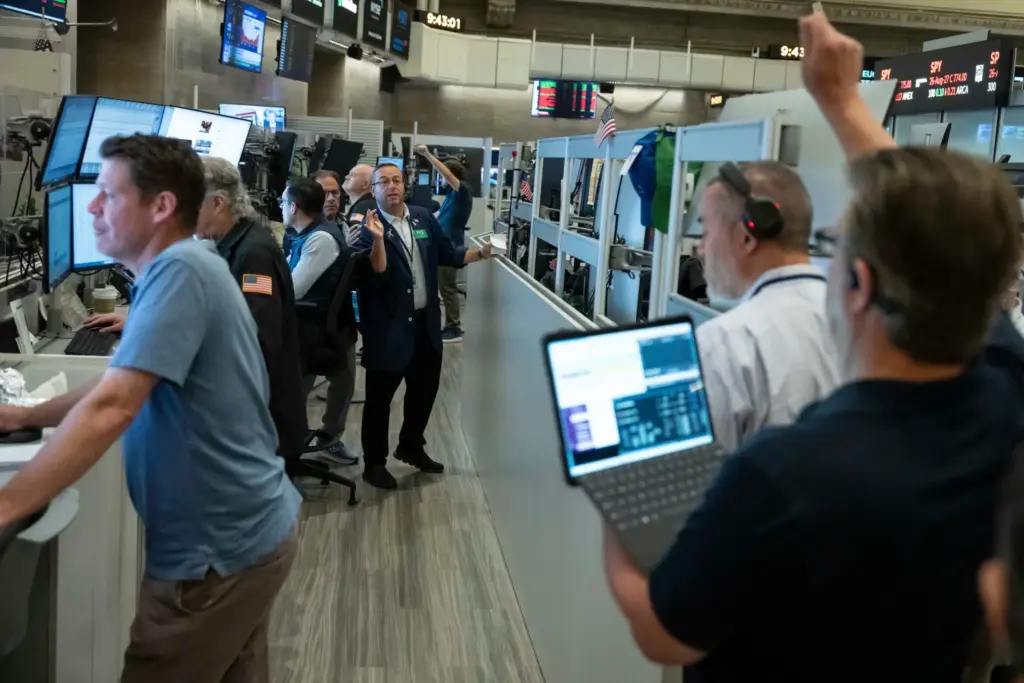
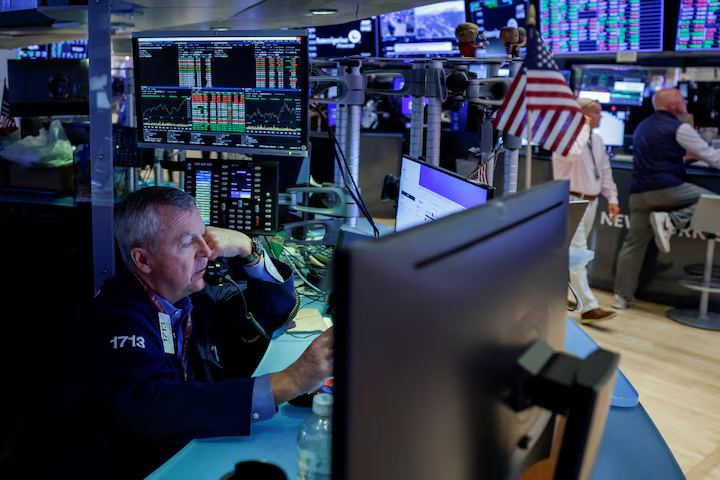
Oil prices fall as Wall Street loses momentum after record rally

Oil prices moved lower on Thursday while U.S. stock markets showed mixed performance, as investors assessed developments in the Middle East and the end of a record-breaking rally on Wall Street.
The decline came one day after the S&P 500 snapped a nine-session winning streak, prompting traders to reassess market momentum amid ongoing geopolitical and economic uncertainty.
Before the opening bell, futures tied to the S&P 500 fell 0.4%, while Nasdaq futures dropped 1.2%. Dow Jones futures, however, gained 0.7%, signaling a mixed start for U.S. markets.
Broadcom and PVH weigh on investor sentiment
Technology stocks came under pressure after semiconductor and software giant Broadcom reported earnings.
Although the company exceeded Wall Street expectations for both revenue and profit, its shares plunged more than 15% in overnight trading. Investors appeared disappointed that management did not raise its full-year guidance despite strong growth and continued demand linked to artificial intelligence.
Broadcom stock had already gained 38% this year and more than tripled over the past two years, setting high expectations among investors.
Retail company PVH Corp., owner of brands including Calvin Klein and Tommy Hilfiger, also suffered a sharp selloff. Shares dropped 23% after the company lowered its full-year outlook despite posting stronger-than-expected quarterly results.
Executives cited tariffs and the ongoing Iran conflict as factors likely to continue weighing on business performance.
Oil prices retreat after ceasefire developments
The biggest market move came in the energy sector.
Brent crude fell $2.42 to $95.39 per barrel, while U.S. benchmark crude declined $2.30 to $93.72 per barrel.
The drop followed news that Israel and Lebanon had agreed to renew a fragile ceasefire and establish security zones in southern Lebanon designed to limit Hezbollah activity.
Investors also reacted to political developments in Washington, where the U.S. House of Representatives approved a war powers resolution aimed at limiting military action against Iran. The measure marked a rare bipartisan challenge to President Donald Trump’s handling of the conflict.
Oil prices had surged earlier in the week after both Iran and the United States exchanged retaliatory strikes, raising fears of a broader regional escalation.
Investors remain focused on the Strait of Hormuz
Despite recent declines, energy markets remain highly sensitive to developments surrounding the Strait of Hormuz.
The strategic waterway remains partially disrupted due to the ongoing conflict, creating uncertainty for global oil supplies.
Many investors continue to hope that future negotiations between Washington and Tehran will lead to the full reopening of the route, easing pressure on global energy markets and helping reduce fuel costs.
While oil prices remain elevated, they are still below the highs reached during the early stages of the conflict.
Rising yields continue to challenge markets
Bond markets offered some relief after yields stabilized following recent increases.
The yield on the benchmark 10-year U.S. Treasury eased slightly to 4.47%, compared with 4.49% a day earlier. However, yields remain significantly higher than the 3.97% level recorded before the Iran conflict began.
Higher yields have become a growing concern for investors because they increase borrowing costs throughout the economy.
Mortgage rates have already climbed to their highest levels in nine months, while businesses face more expensive financing conditions. Analysts warn that elevated borrowing costs could slow economic growth and limit investment, particularly among smaller companies.
There are also concerns that higher rates could affect spending on artificial intelligence infrastructure projects, one of the key drivers of recent economic growth.
Global markets finish mixed
European markets traded mostly higher during midday trading.
Germany’s DAX index gained 0.6%, while France’s CAC 40 rose 1%. Britain’s FTSE 100 was the exception, slipping 0.5%.
Asian markets closed lower across the board.
Japan’s Nikkei 225 dropped 1.4%, weighed down by losses in major technology stocks. SoftBank Group fell more than 11%, while Shin-Etsu Chemical declined 3.8%.
Hong Kong’s Hang Seng Index lost 1.4%, and China’s Shanghai Composite Index fell 0.8%.
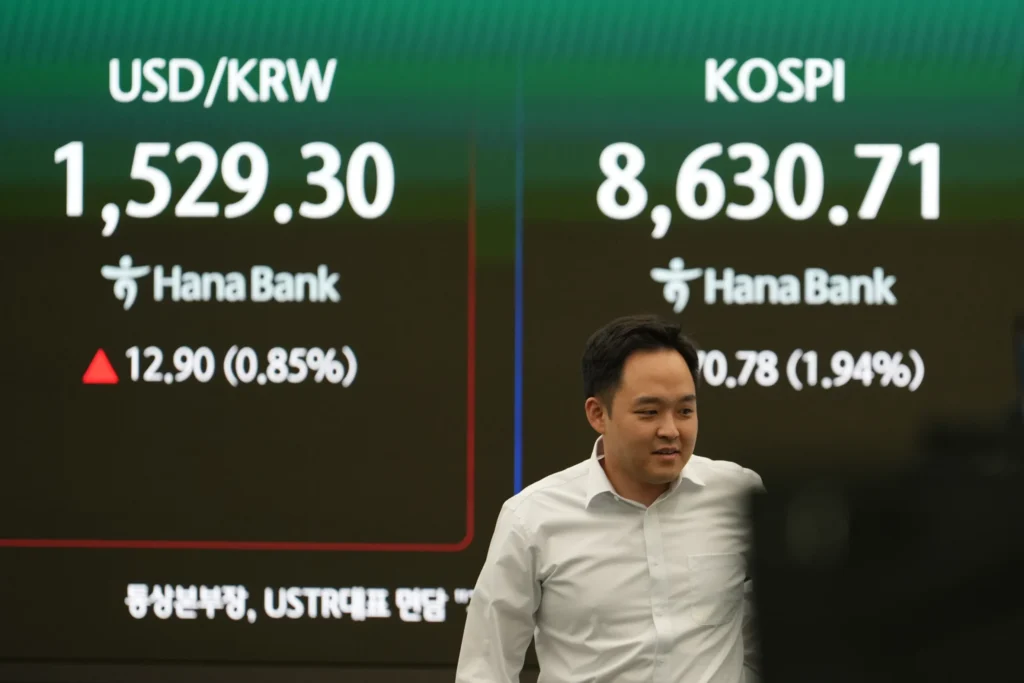
South Korea’s Kospi retreated 1.8%, while Australia’s S&P/ASX 200 declined 1.1%.
Outlook remains uncertain
Despite recent volatility, major stock indexes remain close to record highs. Investors continue balancing optimism about economic growth and artificial intelligence investment against concerns over inflation, higher interest rates, and the ongoing conflict in the Middle East.
For now, developments surrounding oil prices, bond yields, and geopolitical negotiations are likely to remain the key drivers of market sentiment in the weeks ahead.
: 282